How do you dissolve limescale with vinegar?
Ratios, soaking times and safety rules for dissolving limescale with white vinegar on taps, kettles, shower heads and washing machines.
Short answer
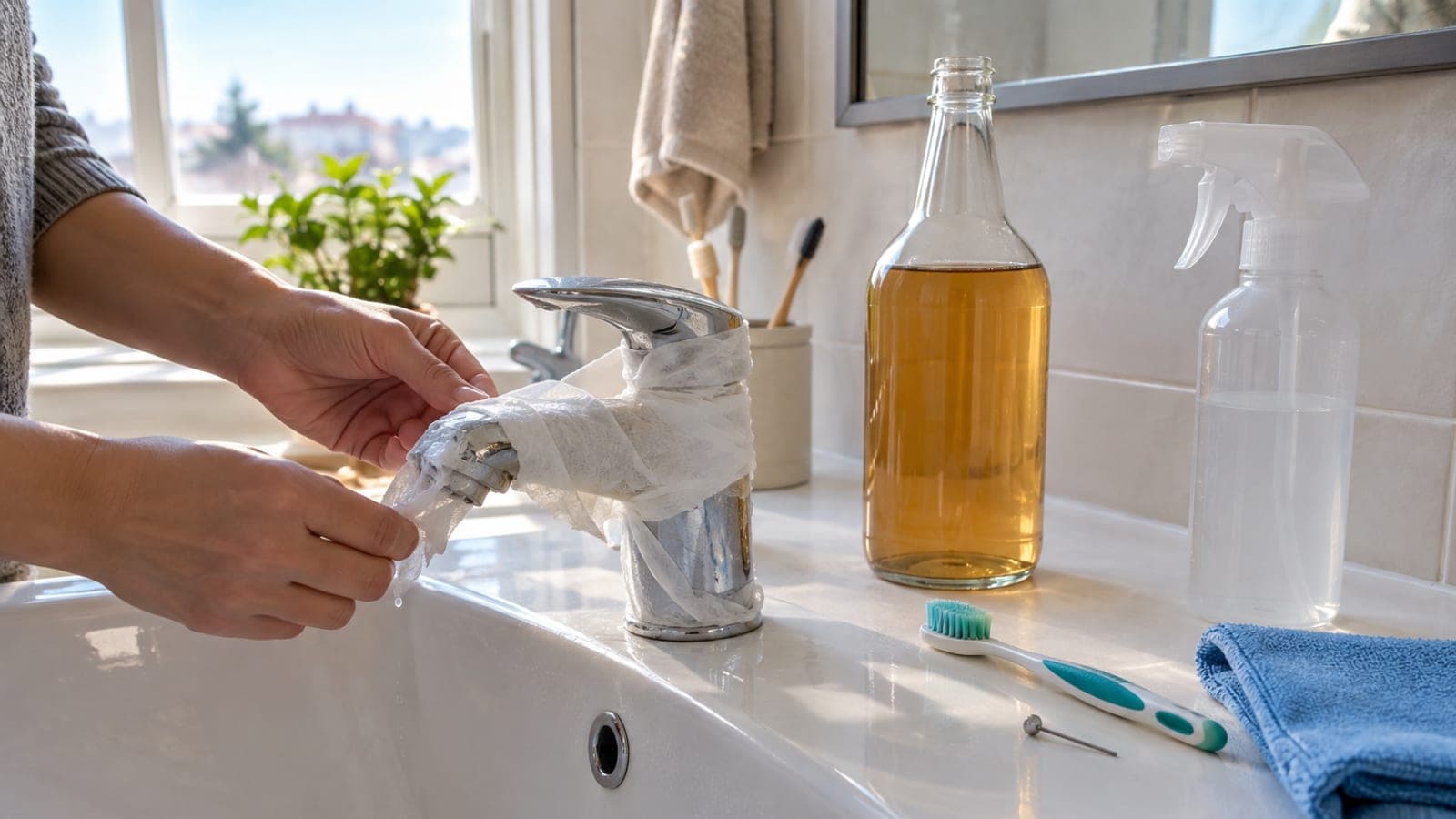
Mix 5% white vinegar with an equal part of water, apply it to the scaled surface, and leave it 30 minutes for a thin film or up to 2 hours for a thick crust. On vertical parts, wrap vinegar-soaked paper towel around the piece and cover it with cling film so it cannot dry out. Scrub with an old toothbrush, rinse with plenty of water, then dry with a microfibre cloth.
What you need
Step by step
Mix the vinegar solution
Fill the spray bottle with equal parts 5% white vinegar and water: 250 ml of each for a 500 ml bottle. Leave the vinegar undiluted where the scale has hardened into a white crust. Choose white vinegar over cider vinegar, since cider vinegar can yellow pale grout and silicone.
Wrap the tap in a compress
Soak paper towel until it is dripping, wrap it around the scaled body of the tap, and seal it with cling film so it stays wet. Leave it 30 to 60 minutes, then scrub around the spout with an old toothbrush. The compress works noticeably better than spraying and wiping because the vinegar cannot run off a vertical surface.
Soak the aerator and shower head
Unscrew the aerator from the tip of the tap by hand or with cloth-wrapped pliers, and disconnect the shower head from its hose. Put both in a jar, cover them with undiluted vinegar and leave for 1 to 2 hours, or overnight if the holes are fully blocked. Afterwards clear any blocked holes with a pin and rinse water through in the reverse direction.
Boil out the kettle
Half fill the kettle with water, add 250 to 300 ml of white vinegar and bring it to the boil once. Unplug the kettle, wait 30 minutes, then pour it out and wipe the loosened scale off the base with a soft sponge. Boil and empty plain water twice more so no smell or taste is left behind.
Run the washing machine empty
Pour 250 ml of white vinegar into the main wash compartment of the detergent drawer, leave the drum completely empty and start the "Cottons 90" cycle, or "Drum Clean" if your machine has it. When the cycle ends, wipe inside the fold of the door seal with a damp cloth and leave the door open for an hour to dry.
Rinse the dishwasher with vinegar
Take out the filter, soak it in a one-to-one vinegar and water mix for 15 minutes, brush it clean and refit it. Then stand a bowl holding 200 ml of white vinegar in the top rack and run "Intensive 70" or "Machine Care" with the machine otherwise empty. Update the water hardness setting in the menu to match your local value.
Rinse, dry and plan a repeat
Vinegar residue left on a surface causes dull patches and streaks, so rinse everything with plenty of water at the end and dry it with a microfibre cloth. In a hard water area, wipe taps and the shower enclosure with a one-to-one vinegar mix weekly and descale appliances every two to three months.
Tips
Watch out
Never mix vinegar with bleach (sodium hypochlorite) or hydrochloric acid cleaners; the chlorine gas released burns the airways within a few breaths. Do not leave vinegar sitting on natural stone, marble or aluminium either, as it leaves permanent dull patches and pitting. Switch on the extractor fan or leave a window ajar while working in the bathroom.
Frequently asked questions
+How long does vinegar take to dissolve limescale?
A thin layer of scale dissolves in about 30 minutes, while a thick crust needs 2 to 8 hours. Warm the vinegar and hold it against the surface with a compress to shorten the wait.
+Is white vinegar or cider vinegar better?
Both are usually 5% acidity, so they dissolve scale equally well. White vinegar is preferred because cider vinegar can leave a yellow tint on pale silicone and tile grout.
+Does vinegar damage a washing machine?
Using 250 ml every two to three months is harmless. Replacing fabric softener with vinegar at every wash can gradually stiffen and crack the door seal and hose gaskets.
+How do I get rid of the vinegar smell?
After rinsing, wipe the surface twice with a clean wet cloth and dry it; the smell fades within an hour or two. For a kettle, boiling and emptying plain water twice is enough.
+How do I prevent limescale in the first place?
Squeegee the shower glass and dry the fittings with a cloth after each use, and set your appliances' water hardness to your local value. In very hard water areas, fitting a filter or softener at the mains inlet is the lasting fix.
Sources and verification
Last verified: 13 Eylül 2026. tell us. Cycle names such as "Cottons 90", "Drum Clean", "Intensive 70" and "Machine Care" vary by brand; check your appliance manual for the equivalent programme.
This content is for information only; for official procedures the relevant institution’s current announcements take precedence. Details: disclaimer.