How do you get your combi boiler ready for winter?
Check your combi boiler and radiators yourself in about an hour, before the cold weather arrives.
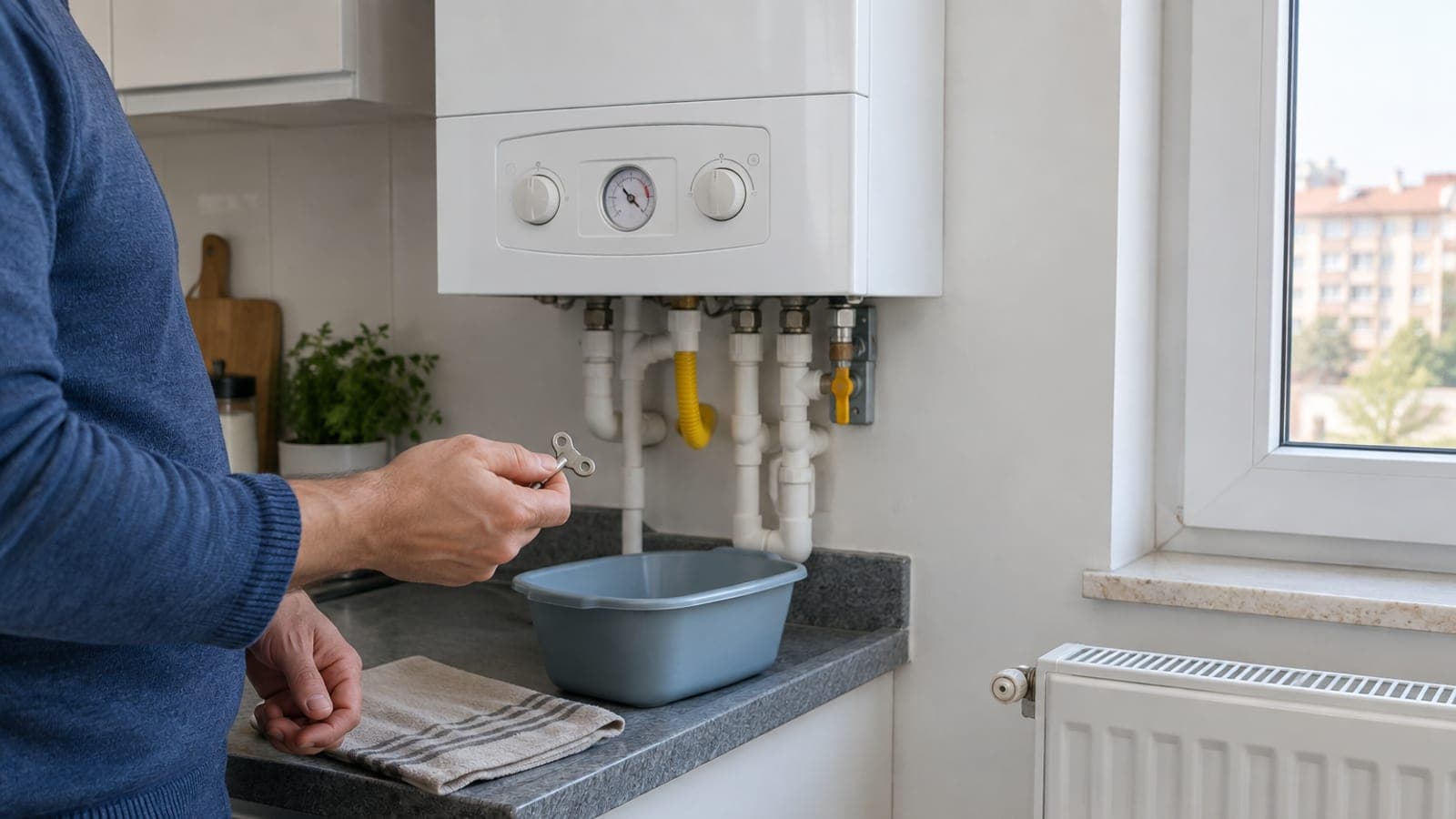
Short answer
Bring the pressure on the boiler gauge to around 1.5 bar, bleed every radiator from the valve at its top corner until air stops hissing out, then run the boiler in "Heating" mode for 20-30 minutes and confirm each radiator warms from top to bottom. Book an authorised service visit for the yearly gas leak and flue check.
What you need
Step by step
Read the pressure gauge
Look at the round gauge on the boiler's front panel, or the bar figure on the digital display. With the system cold, the needle should sit in the green band between 1.2 and 1.5 bar. Below 1 bar you need to add water; above 2.5 bar you need to drain some. Wrong pressure will push the boiler into a fault code.
Bleed the radiators
Switch the boiler off, then turn the bleed screw at the top corner of each radiator a quarter turn anticlockwise with the bleed key, holding a basin underneath. Close the screw once the hissing stops and steady water appears. Start with the radiators furthest away and on the top floor; trapped air leaves a radiator cold at the top.
Top the pressure back up
Slowly open the blue or white filling valve under the boiler; you will hear the water flowing. Close it fully once the gauge reads 1.5 bar. Do this after bleeding, because releasing air drops the pressure again.
Test the boiler in heating mode
Start the boiler, set the mode dial to "Heating" (the radiator symbol) and the water temperature to 60-65 °C. If you have a room thermostat, turn it up to 23 °C and listen for the burner firing. After 20-30 minutes, feel every radiator by hand; the top and bottom should both be warm.
Clean behind the radiators and around the boiler
Clear dust from between the radiator fins with a narrow vacuum nozzle and a long-handled brush, since a layer of dust noticeably cuts heat output. Remove any boxes, detergent bottles or curtains blocking the ventilation grille of the cupboard housing the boiler.
Check the filter and condensate drain
Visually inspect the return-line strainer and the condensate drain hose under the boiler. Clear any blockage or limescale build-up in the hose, and photograph any dripping to show the engineer. If cleaning the filter means shutting off the water, leave that job to the service technician.
Book the annual service
Call the manufacturer's helpline or use the brand's app and choose "Maintenance" to book a slot. The engineer cleans the burner, tests for gas leaks, measures flue gases and checks the safety valve. Call in late September, because October and November slots fill up fast.
Review gas and flue safety
Brush soapy water onto the hose and union between the boiler and the gas meter and watch for bubbles; if any appear, close the gas valve and call the service. Also check that the outside opening of the balanced flue is not blocked by a bird's nest, plastic bag or packed snow.
Tips
Watch out
Never work on the burner, gas valve or flue connection of a gas boiler yourself; a mistake can cause a carbon monoxide leak and fatal poisoning. If you smell gas, do not touch any electrical switch: open the windows, close the gas valve, go outside and call the gas emergency line (187 in Türkiye).
Frequently asked questions
+What pressure should a combi boiler be at?
Between 1.2 and 1.5 bar with the system cold is ideal. Rising to 2-2.5 bar while running is normal, but above 3 bar the safety valve will dump water and you need an engineer.
+Why is my radiator hot at the bottom and cold at the top?
Air is trapped inside the radiator. Open the bleed screw at the top corner until the hissing stops, then top the boiler pressure back up to 1.5 bar.
+How often should a combi boiler be serviced?
Once a year is enough, ideally in September or October before the heating season. Skipping the service on a boiler still under warranty can void that warranty.
+How long does a boiler service take and what is included?
It takes 45-60 minutes on average. The engineer cleans the burner and heat exchanger, tests for gas leaks, measures flue gases, adjusts pressure, checks the safety valve and leaves a service record.
+Does turning the boiler off at night save gas?
No, reheating a cold house burns more gas. Dropping the thermostat to 18-19 °C overnight is the more efficient approach.
Sources and verification
Last verified: 13 Eylül 2026. tell us. Pressure figures and menu names follow common Turkish combi boiler models, and 187 is the gas emergency line in Türkiye; use your local emergency number elsewhere.
This content is for information only; for official procedures the relevant institution’s current announcements take precedence. Details: disclaimer.