How do you start learning a foreign language from scratch?
A concrete plan built on one coursebook, 25 minutes a day and two speaking sessions a week, taking you through the A1 level.
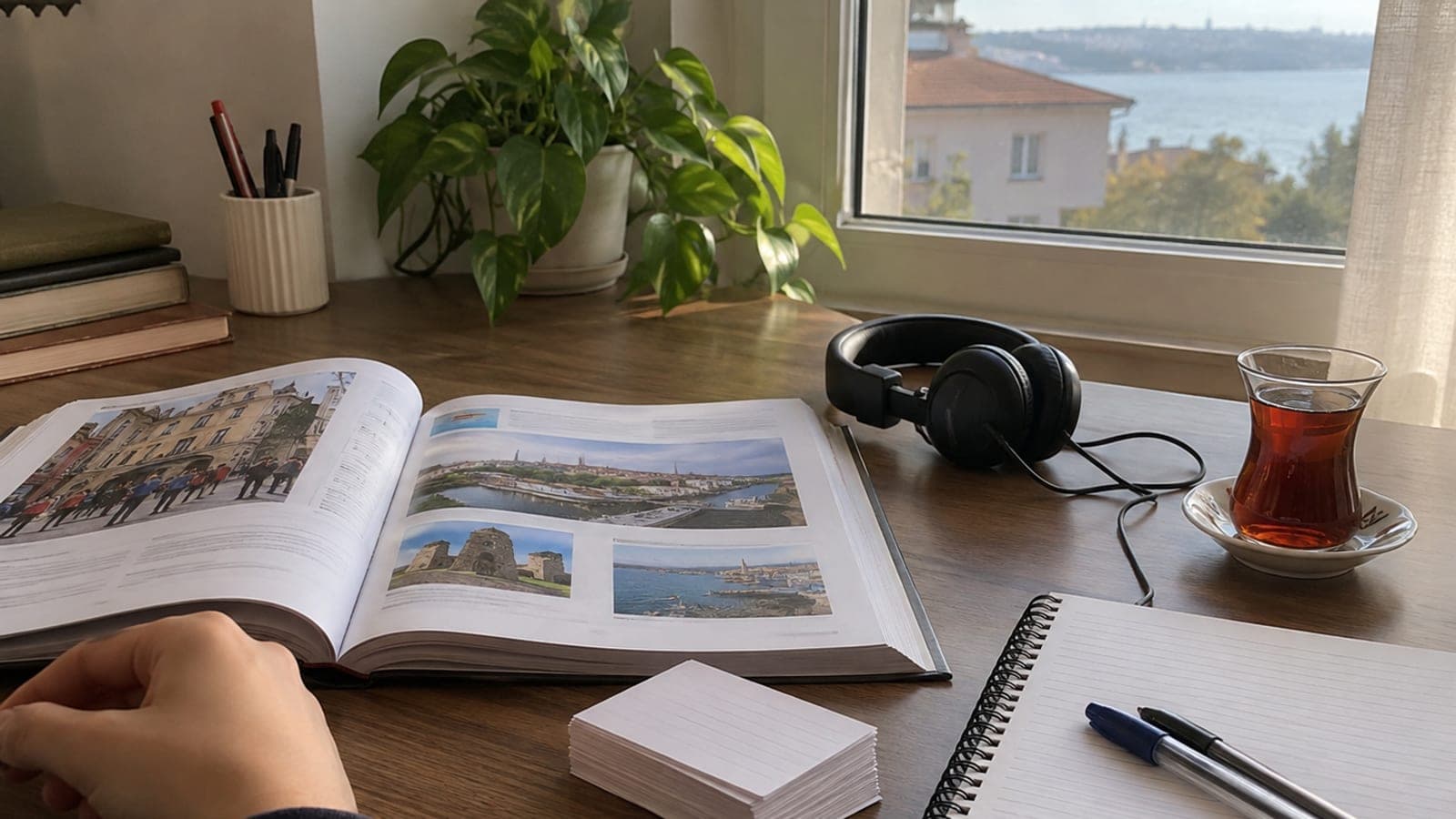
Short answer
Pick one A1 coursebook, block 25 minutes a day in your calendar, add 10 new words to Anki, listen for 10 minutes in the target language, and speak twice a week for 30 minutes. Do not swap resources for the first six weeks, then measure yourself with the book's unit test. A1 takes roughly 90-100 hours, which lands around the four to five month mark at this pace.
What you need
Step by step
Write your goal with a level and a date
On the first page of the notebook write a single line such as "A1 in five months", and underneath it note why you are learning: a job interview, a trip, an exam. On the CEFR scale, A1 means introducing yourself and handling simple everyday needs. Without a concrete target you cannot decide which book, how many units, or what weekly pace to commit to.
Lock 25 daily minutes into your calendar
Open Google Calendar, tap the + button at the bottom right and choose "Event". Set the time range to 25 minutes, switch "Repeat" to "Every day", and set the notification to 10 minutes before. Short daily contact is what makes vocabulary stick, far more than one long session per week.
Choose one coursebook and set a weekly rhythm
Buy a single book marked A1 and download the audio from its QR code to your phone. Fix the week: three days on a new unit, two days on the workbook, one review day, one day off. Adding a third resource at the same time makes it impossible to tell whether you are actually progressing.
Build a 10-card-a-day Anki deck
Download Anki from apps.ankiweb.net, or AnkiDroid free on Android. Use "Create Deck" at the bottom of the home screen to make a deck called "A1 Vocabulary", then hit "Add" at the top, set Type to "Basic", and put the word on the front with the meaning and one example sentence on the back. Open the gear icon next to the deck, choose "Options", and cap new cards at 10 per day.
Record every new word out loud
Search the word on forvo.com and listen to a native speaker's recording three times. Then say the same word into your phone's voice recorder app and compare it with the original. Five minutes of this each day stops a mispronounced word from hardening into a habit months later.
Listen for 10 minutes a day in the target language
In YouTube, open the gear icon in the bottom bar, choose "Settings" > "Playback speed" > 0.75, and turn on the subtitle (CC) button. On Netflix, use the "Audio and Subtitles" menu in the player to set both audio and subtitles to the target language. Do not hunt for new material in the early months; replay the same five-minute clip for a whole week.
Speak for 30 minutes twice a week
Set up a profile on Tandem or HelloTalk, add your target language under "Learning", and pick a native speaker from the "Find" tab. If you prefer to pay, use the "Community Tutor" filter on italki's "Find a Teacher" screen. Before each call, write the 10 sentences you learned that week in your notebook and glance at them while you talk.
Measure your level at the end of week six
Do the book's unit tests against the clock, then take one of the free online placement tests. Copy your mistakes onto the last page of the notebook as a "review list" and dedicate the next two weeks of review days to it. Skip the measurement and you will quietly start avoiding the topics you never learned.
Tips
Watch out
The most common mistake is treating a daily app streak as learning. Five minutes of tapping across four different apps does not replace finishing units in one book on a schedule, and if you change resources or methods within the first six weeks you never find out what actually worked.
Frequently asked questions
+How many new words should I learn per day?
Ten new words a day is enough. With the older cards that come due alongside them, that takes 15 to 20 minutes; push it to 30 and the review load multiplies within weeks until you quit.
+How long does it take to finish A1?
Common estimates put A1 at 90 to 100 hours of lessons and study. At 25 minutes a day that is roughly four to five months, slightly less if you add two speaking sessions a week.
+Should I take a course or study on my own?
Self-study works for A1, but feedback on speaking and pronunciation has to come from someone else. The cheapest combination is a coursebook on your own plus two conversation partner sessions a week.
+Is an app like Duolingo enough on its own?
No. Apps are good for vocabulary and recognition drills, but they do not give you coherent units, extended listening, or real back-and-forth conversation. You need a book and a live speaker for that.
+Can adults still learn a foreign language?
Yes. Adults pick up grammar and vocabulary faster than children; the real gap shows up in pronunciation, and five minutes of daily record-and-compare practice closes most of it.
Sources and verification
Last verified: 13 Eylül 2026. tell us. Menu labels follow the English interface of Google Calendar, Anki, YouTube, Netflix and italki; names may differ slightly in other UI languages.
This content is for information only; for official procedures the relevant institution’s current announcements take precedence. Details: disclaimer.