How do you clean limescale off a tap and shower head with vinegar?
Dissolve crusted limescale on taps and shower heads in 30 to 60 minutes using white vinegar and a plastic bag.
Short answer
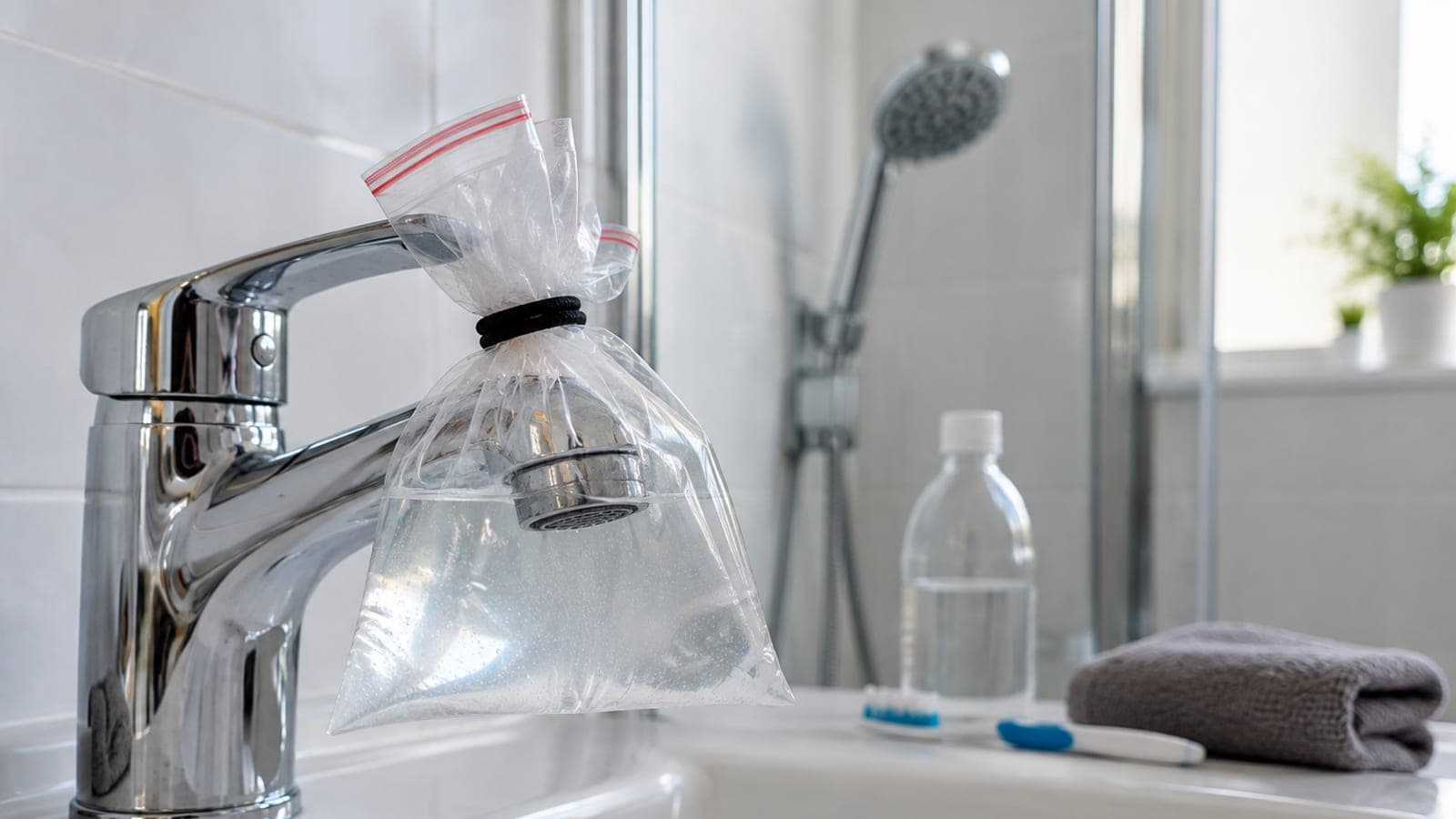
Mix white vinegar with water 1:1, pour it into a bag, tie the bag over the tap spout or shower head with a rubber band and leave it 30-60 minutes. Scrub the holes with an old toothbrush, rinse under running water and dry with a microfibre cloth. For thick scale, use undiluted vinegar and soak up to two hours.
What you need
Step by step
Mix the vinegar solution
Combine 250 ml white vinegar with 250 ml warm water in a cup; keep the water around 40-50 C and never use boiling water. If the scale is a white crust 1-2 mm thick, skip the water and use vinegar straight. Warm vinegar dissolves scale roughly twice as fast as cold vinegar.
Tie the bag onto the tap
Pour the solution into the bag, lift it so the spout sits fully submerged, then fasten the bag mouth tightly around the tap body with a rubber band. Half full is enough; any more and the weight drags the bag off. Repeat for the shower head, and if the head is fixed high on a riser, seat the bag over the hose and pull the band tight.
Leave it 30-60 minutes
Allow 30 minutes for normal scale and 60-120 minutes for thick, yellowed deposits. Set a timer on your phone and never leave vinegar on overnight, because long contact can dull chrome plating and rubber seals. Do not open the tap while it soaks.
Brush and poke the holes
Remove the bag and pour the vinegar down the drain. Rub the silicone nozzles of the shower head with your fingertip, clear blocked holes one by one with a toothpick or needle, and brush the tap aerator in small circles with the toothbrush. The scale is soft now, so it crumbles away without scraping.
Treat leftovers with baking soda
For remaining grey marks, mix 2 tablespoons of baking soda with a few drops of water into a paste, spread it on, wait 10 minutes and scrub with the toothbrush. Baking soda gives mechanical bite without being abrasive. Do not mix it with vinegar to make it fizz; the two simply neutralise each other.
Rinse and dry
Run the tap wide open for 1-2 minutes to flush out trapped vinegar and scale flakes, then do the same with the shower. This clears both the smell and the acid residue. Finish by wiping everything dry with a microfibre cloth, since chrome left wet grows fresh water spots within a day.
Soak removable parts separately
If the aerator, the small screen at the tap mouth, or the hand shower unscrews easily, turn it anticlockwise by hand rather than with pliers. Plug the basin, drop the parts into a bucket of undiluted vinegar and leave them an hour. Submerging the whole screen gives a cleaner result than the bag method, and remember to seat the washer when reassembling.
Put the repeat in your calendar
In hard-water cities such as Istanbul, Ankara or Konya, repeat this every month; where the water is soft, every two to three months is enough. A quick dry wipe with a microfibre cloth once a week between cleans prevents most of the buildup.
Tips
Watch out
Never mix vinegar with bleach or any chlorine-based drain acid; the reaction releases toxic chlorine gas. On gold-tone, brass, nickel-plated or matte black fittings, keep contact under 15 minutes or the finish dulls permanently. Do not let vinegar drip onto natural stone such as marble or travertine, as it etches the surface.
Frequently asked questions
+Does vinegar damage the chrome finish on a tap?
On standard chrome, one to two hours of contact is harmless. On gold-tone, brass and matte black fittings, stay under 15 minutes and always rinse well and dry afterwards.
+Can I clean the shower head without unscrewing it?
Yes. Tying a bag of vinegar around the head for 30-60 minutes is enough in most cases. Removing it is only necessary when the internal screen is completely blocked.
+How often should I repeat this?
It depends on water hardness. Once a month in hard-water areas like Istanbul and Ankara, every two to three months where the water is soft.
+Will the vinegar smell linger in the bathroom?
After running the tap wide open for a minute or two and drying the surfaces, the smell fades within 15-20 minutes. Opening a window shortens that further.
+Is a commercial descaling spray better than vinegar?
It works faster on thick scale, but most contain strong acids and carry more risk for the finish. For monthly upkeep, vinegar is both cheap and safe.
Sources and verification
Published: September 12, 2026. tell us. Hardness figures and city examples refer to Turkey; adjust the repeat interval to your local water hardness.
This content is for information only; for official procedures the relevant institution’s current announcements take precedence. Details: disclaimer.