How do you choose winter tyres and measure tread depth?
Read the tyre size off your registration document, pick the right winter tyre, then check tread depth with a gauge, a coin or the TWI bars.
Short answer
Read the tyre size from your vehicle registration document (for example 205/55 R16 91V) and buy a winter tyre that carries the 3PMSF snowflake mark. Measure tread depth at three separate points on each tyre: below 4 mm winter grip is largely gone, and 1.6 mm is the legal limit. In Turkey winter tyres are compulsory for commercial vehicles between 1 December and 1 April.
What you need
Step by step
Read the correct size from the documents
Check the tyre size line on the reverse of the vehicle registration document. If it is missing, open the driver's door and read the label on the door frame. In 205/55 R16 91V, 205 is width in mm, 55 the aspect ratio, 16 the rim diameter in inches, 91 the load index and V the speed rating. On winter tyres you may drop one speed rating step, but never reduce the load index.
Check the 3PMSF and DOT markings
Look on the sidewall for the snowflake inside a three-peak mountain, the 3PMSF symbol. An "M+S" marking alone is accepted by regulation, but genuine winter performance comes with 3PMSF. On the same sidewall read the last four digits of the DOT code: 2225 means week 22 of 2025. Avoid old stock more than three years old.
Measure tread at three points with a gauge
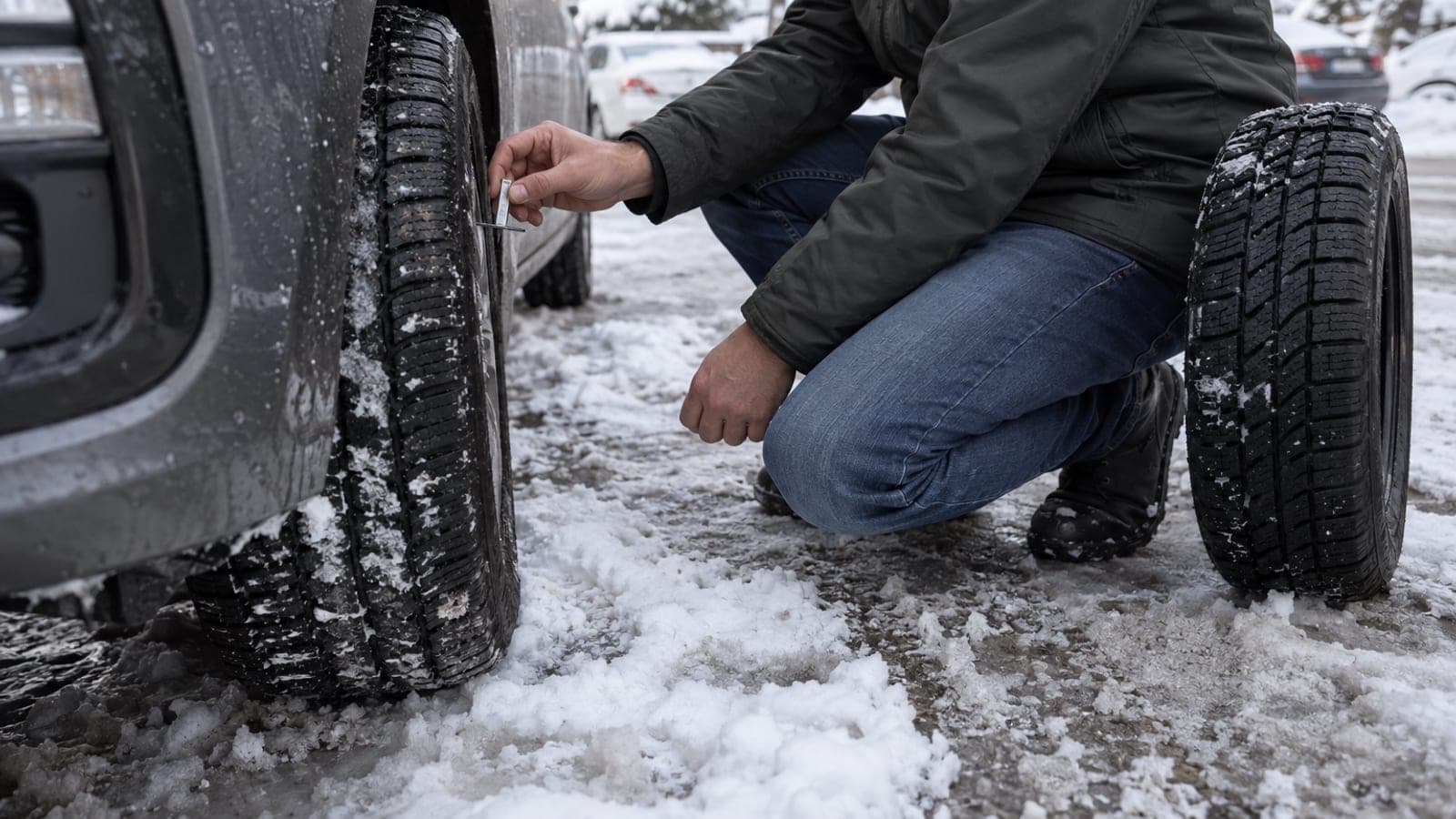
Rest the gauge pin at the bottom of a main groove and press the body flat against the tread surface, then read the value. Take a reading from three separate grooves on each tyre, inner shoulder, centre and outer shoulder, and record the lowest number. Repeat for all four tyres; the whole check takes about five minutes.
Use a coin or the TWI bars instead
Slide a coin upright into the groove. If the milled edge band disappears completely, tread is roughly above 4 mm. Alternatively find the small raised bridges in the tread, the tread wear indicators. If the tread surface is level with a TWI bar, depth is 1.6 mm and the tyre is legally worn out.
Decide based on the reading
At 4 mm or more the tyre will see out this winter. Between 3 and 4 mm, plan a mid-season replacement because braking distances on snow stretch noticeably. Below 3 mm, replace it. If two tyres on the same axle differ by more than 2 mm, traction becomes uneven, so change them as a pair.
Set the pressure and finish the fitting
When the new tyres go on, inflate them about 0.2 bar above the door label figure, since pressure drops roughly 0.1 bar for every 10 degree fall in temperature. Ask for wheel balancing, and budget 400-900 TL if alignment is needed too. Mark the front and rear positions of the removed summer tyres with chalk and store them lying flat in a cool, dark place.
Tips
Watch out
Tread below 1.6 mm breaks traffic regulations, and after an accident an insurer may assign you a share of the fault. A common mistake is treating summer-natured tyres marked only "M+S" as winter tyres; below 7 degrees their rubber hardens and braking distances grow.
Frequently asked questions
+When does the winter tyre requirement start in Turkey?
It applies to commercial passenger and freight vehicles from 1 December to 1 April. Private cars face no nationwide requirement, though individual provincial governors can make it mandatory locally.
+At what tread depth should a winter tyre be replaced?
The legal limit is 1.6 mm, but a winter tyre loses most of its grip on snow and ice below 4 mm. Treat 4 mm as your practical replacement threshold.
+Can all-season tyres replace winter tyres?
If they carry the 3PMSF mark they count as winter tyres under the regulations. In harsh winter conditions and on mountain roads they will not match a true winter tyre's braking performance.
+How do I find out a tyre's production date?
Read the last four digits of the DOT code on the sidewall. The first two are the week and the last two the year, so 3623 means week 36 of 2023.
+Can I keep using winter tyres through the summer?
You can, but the soft rubber wears fast in heat, braking distances grow and fuel use rises. Once average temperatures pass 7 degrees, switching back to summer tyres is cheaper.
Sources and verification
Last verified: 13 Eylül 2026. tell us. Prices, document references and mandatory-period dates reflect the Turkish market and traffic regulations.
This content is for information only; for official procedures the relevant institution’s current announcements take precedence. Details: disclaimer.