How do you set up an aquarium and balance the water?
A measured way to build a 60-litre freshwater tank from scratch and cycle the water over 3-4 weeks before any fish go in.
Short answer
Put the 60-litre tank on a flat, load-bearing surface, spread 5 cm of rinsed sand, fit an internal filter and a 100 W heater, and set the thermostat to 26 °C. Dechlorinate the tap water with Tetra AquaSafe or Sera Aquatan, dose a bacteria starter such as JBL Denitrol, then wait 3-4 weeks. Add the first fish, a few at a time, only once ammonia and nitrite read 0 mg/L and nitrate sits under 25 mg/L.
What you need
Step by step
Prepare the spot and place the tank
Choose a surface that can carry the weight, out of direct sun and at least a metre from the window, within 1.5 metres of a socket. Filled with 60 litres, the total weight passes 80 kilograms, so skip flimsy shelves and bookcases. Lay a 3-5 mm polystyrene sheet between the glass and the furniture, then check the tank is level with a spirit level.
Rinse the sand and lay out the decor
Swirl the sand in a bucket 4-5 times until the water runs clear, and never use detergent. Spread it in the empty tank on a slope, roughly 6 cm at the back and 4 cm at the front. Set stones and driftwood on top of the sand without letting them press against the glass; avoiding limestone keeps the pH from creeping up.
Fit the filter and heater, set the temperature
Suction-cup the internal filter into a back corner with its outflow just breaking the surface. Mount the 100 W heater horizontally or at a slight angle, 3-4 cm above the sand, and turn the thermostat dial to 26 °C. Do not switch either on before the tank holds water; a dry-running heater will crack the glass.
Fill the tank and remove the chlorine
Rest an upside-down plate on the sand and pour the water onto it so the substrate stays put. Aim for 22-26 °C from the tap and avoid dumping in cold mains water in winter. Dose 5 ml of Tetra AquaSafe per 10 litres, add the full amount for the whole volume in one go on the first fill, then start the filter.
Add the bacteria starter and begin the fishless cycle
With the filter running, dose JBL Denitrol or Sera Nitrivec at the label rate for 60 litres. Feed the colony a pinch of fish food daily, about 2-3 flakes, or use pure ammonia to hold ammonia at 1-2 mg/L. Keep the light to 6 hours a day, since anything more just feeds algae.
Test ammonia, nitrite and nitrate every other day
Draw 5 ml into the test vial, run the NH4/NH3 and NO2 tests, and write the results in a notebook with the date. Ammonia climbs over the first 10 days, nitrite then spikes, and around week three both fall while nitrate appears. Strip tests only give a rough picture, so base decisions on drop tests.
Add the first fish once the readings settle
The cycle is done when ammonia reads 0 mg/L, nitrite 0 mg/L and nitrate under 25 mg/L, which usually takes 3-4 weeks. For 60 litres, start with no more than 5-6 small fish. Float the bag on the surface for 15 minutes, add a cup of tank water every 5 minutes for the next quarter hour, then net the fish across and discard the bag water.
Set up a weekly maintenance routine
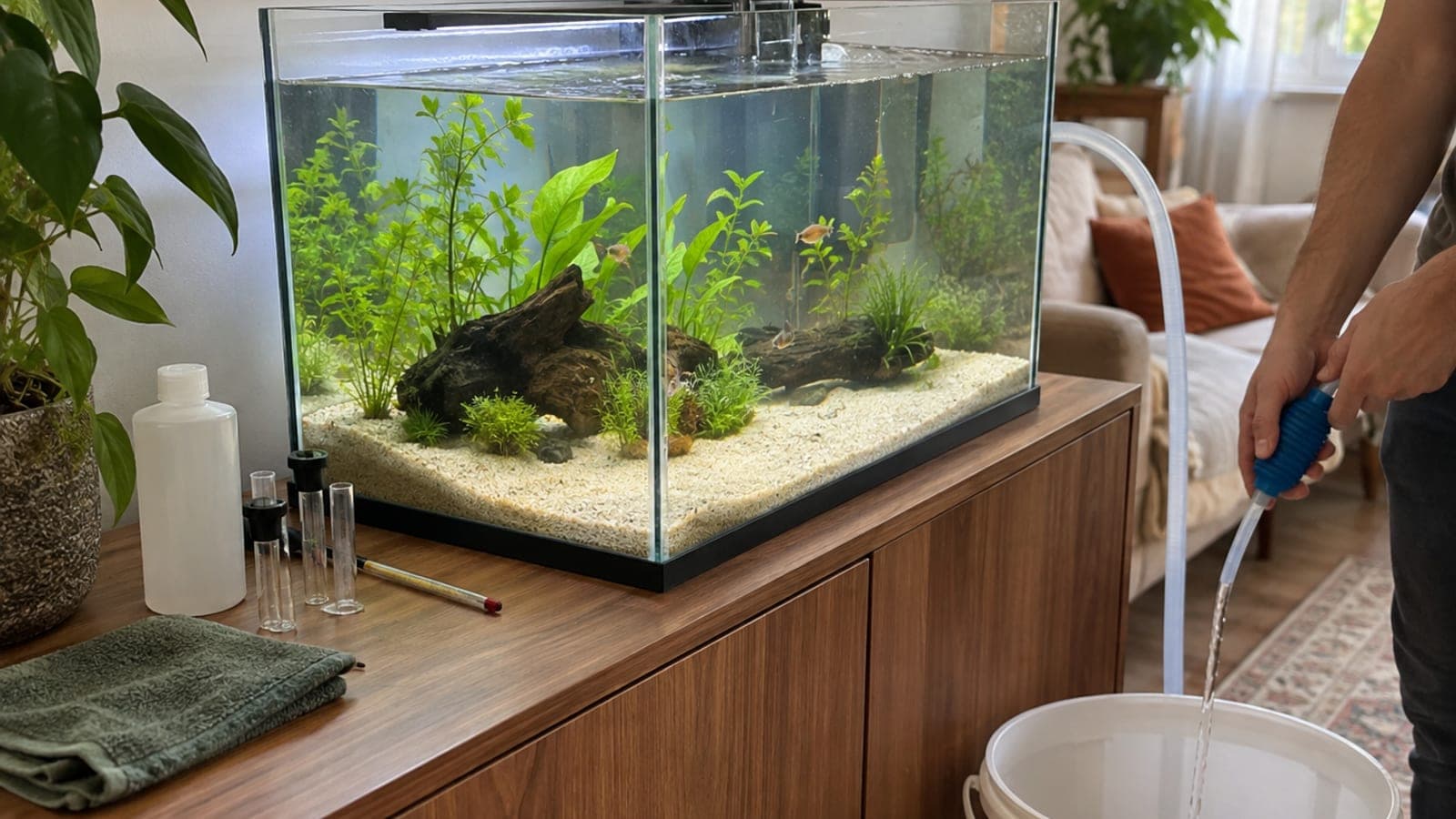
Each week siphon 20-25 percent of the volume off the sand surface, 12-15 litres in a 60-litre tank, and replace it with conditioned water at the same temperature. Scrape the inside of the glass, and once a month squeeze the filter sponge gently in water taken from the tank itself. Feed once a day, only as much as the fish finish in two minutes.
Tips
Watch out
The most common mistake is buying fish the day you set the tank up. With no bacteria colony in the filter yet, ammonia reaches toxic levels within 2-3 days and the fish die of gill burn, which is what new tank syndrome means. Never rinse the filter sponge under the tap either; chlorine kills the bacteria and resets the whole cycle.
Frequently asked questions
+How long does an aquarium cycle actually take?
With a bacteria starter at 26 °C it usually runs 3-4 weeks, and up to 6 weeks without one. Decide it is finished from ammonia and nitrite reading 0 mg/L, not from the calendar.
+Is letting tap water stand enough to remove chlorine?
Free chlorine gasses off within 24 hours, but many mains supplies also carry chloramine, which standing will not remove. That is why a conditioner such as Tetra AquaSafe or Sera Aquatan is the safer route.
+Do I need to lower my pH?
Most mains water sits between pH 7.2 and 8.0, and platies, mollies, guppies and goldfish live fine in that range. Choosing fish that match your water is far less risky than adjusting pH with chemicals.
+What does the setup cost?
A 60-litre tank, internal filter, heater, sand, conditioner, bacteria starter and a drop test kit add up to a mid-range starter budget at pet shop prices, with the tank and test kit as the biggest items.
+The water has turned green, what should I do?
Cut the light to 6 hours a day, move the tank away from sunlight, and change 20 percent of the water three days in a row. Halving the food also cuts off the phosphate source.
Sources and verification
Last verified: 13 Eylül 2026. tell us. Product names and dosing follow European retail packaging; hard-water advice reflects typical Central Anatolian mains supplies.
This content is for information only; for official procedures the relevant institution’s current announcements take precedence. Details: disclaimer.