How do you start knitting from scratch?
A step-by-step first project for new knitters, from picking needles and yarn to finishing a square swatch.
Short answer
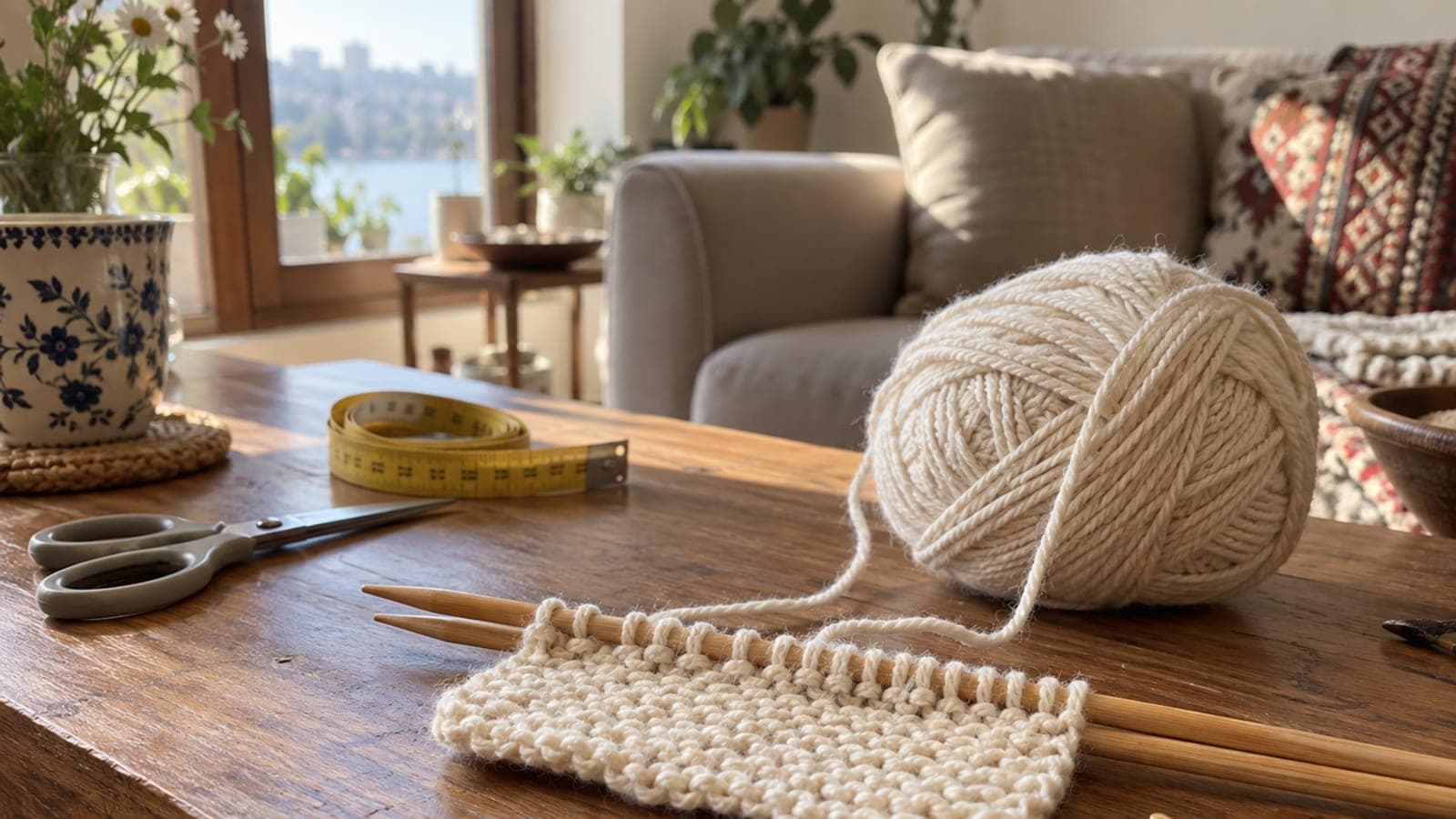
Buy a pair of 4-4.5 mm bamboo needles and one 100 g ball of light-colored worsted acrylic. Cast on 20 stitches, knit every row until the piece measures 20x20 cm, then bind off. The square takes about 3-4 hours and teaches casting on, the knit stitch, and binding off. Move on to a scarf once it's done.
What you need
Step by step
Match the needles to the yarn
Look at the needle symbol on the yarn label and buy the size printed there, usually 4-4.5 mm. Choose acrylic over wool for a first attempt: it resists breaking and costs little. Bamboo needles grip better than metal, so stitches are far less likely to slide off.
Find the end inside the ball
Push a finger into the center of the ball and pull out the inner end, because working from the outside makes the ball roll and tangle. The first tug usually brings a small clump with it; set that aside and find the single strand that feeds smoothly. Keep the ball in a jar or bag while you work.
Cast on 20 stitches
Leave a tail of about 50 cm, make a slip knot, and slide it onto one needle. Cast on 20 stitches total using either the long-tail thumb method or by wrapping the yarn around a single needle. Keep them loose enough to slide; tight stitches make the first row impossible. Expect this to take 10 minutes and to be redone once or twice.
Knit every row
Hold the working needle in your right hand, insert it into the first stitch, wrap the yarn around it, and pull a new loop through. Work all 20 stitches this way, then swap the needles and start the next row. Knitting every row produces garter stitch, which looks identical on both sides.
Keep going to 20 cm
Lay the piece flat on a table and measure with the tape; the target length is 20 cm. That works out to roughly 40-50 rows, or 3-4 hours, and you don't have to do it in one sitting. Always finish a row before setting the work down, or you'll lose track of where you stopped.
Bind off the stitches
Knit the first two stitches, then use the left needle to lift the first one over the second and drop it off. Repeat knit one, lift over, until a single stitch remains on the needle. Pull the yarn through that last stitch and cut it, leaving a 15 cm tail.
Weave in the ends and wash
Thread each tail onto the yarn needle, run it 4-5 cm along the wrong side of the fabric, then double back and trim the excess. Don't tie knots, since they work their way to the surface over time. Hand wash in lukewarm water, press the piece in a towel, and dry it flat so the edges relax.
Start a second project
With the same needles, cast on 30 stitches and knit a plain scarf 150 cm long; budget about 300 g of yarn and 12-15 hours. After that try seed stitch by alternating one knit and one purl, then 2x2 ribbing. Test each new technique on a 10x10 cm swatch first to avoid wasting yarn.
Tips
Watch out
The most common beginner mistake is casting on too tightly: the needle won't fit into the stitch on the next row, the yarn snaps, and the work starts over. Each stitch should slide back and forth freely on the needle. Also, never carry metal needles with live stitches in a bag, since dropped stitches unravel the fabric downward. Cap the needle tips with rubber stoppers or a cork.
Frequently asked questions
+What needle size should I start with?
4-4.5 mm needles are ideal for beginners: the stitches are easy to see and the work grows quickly. Starting with 2-3 mm needles strains your eyes and kills motivation.
+Should I buy acrylic or wool?
Use acrylic for the first project. It's cheap, can be ripped out and reknit many times, and won't felt. Switch to wool once the basic techniques feel automatic.
+Why do the edges of my knitting curl and wave?
Curling is normal in single-color stockinette and mostly settles after washing and drying flat. For a permanent fix, work the first and last three stitches of every row in ribbing.
+How many balls of yarn does one scarf need?
A worsted-weight scarf 20 cm wide and 150 cm long takes 250-300 g, so three 100 g balls are enough. Buy one extra from the same lot to be safe.
+How much should I knit each day?
About 30-45 minutes, four or five days a week, is plenty. Stretch your fingers and roll your neck every 20 minutes to avoid hand and shoulder pain.
Sources and verification
Last verified: 13 Eylül 2026. tell us. Prices are given in Turkish lira and reflect yarn shops and wholesale markets in Turkey; needle sizes follow the metric scale (4-4.5 mm is sold locally as size 7-8).
This content is for information only; for official procedures the relevant institution’s current announcements take precedence. Details: disclaimer.