How do you check your car battery before winter?
With a multimeter and a quick visual inspection, find out in 20 minutes whether your battery will make it through winter.
Short answer
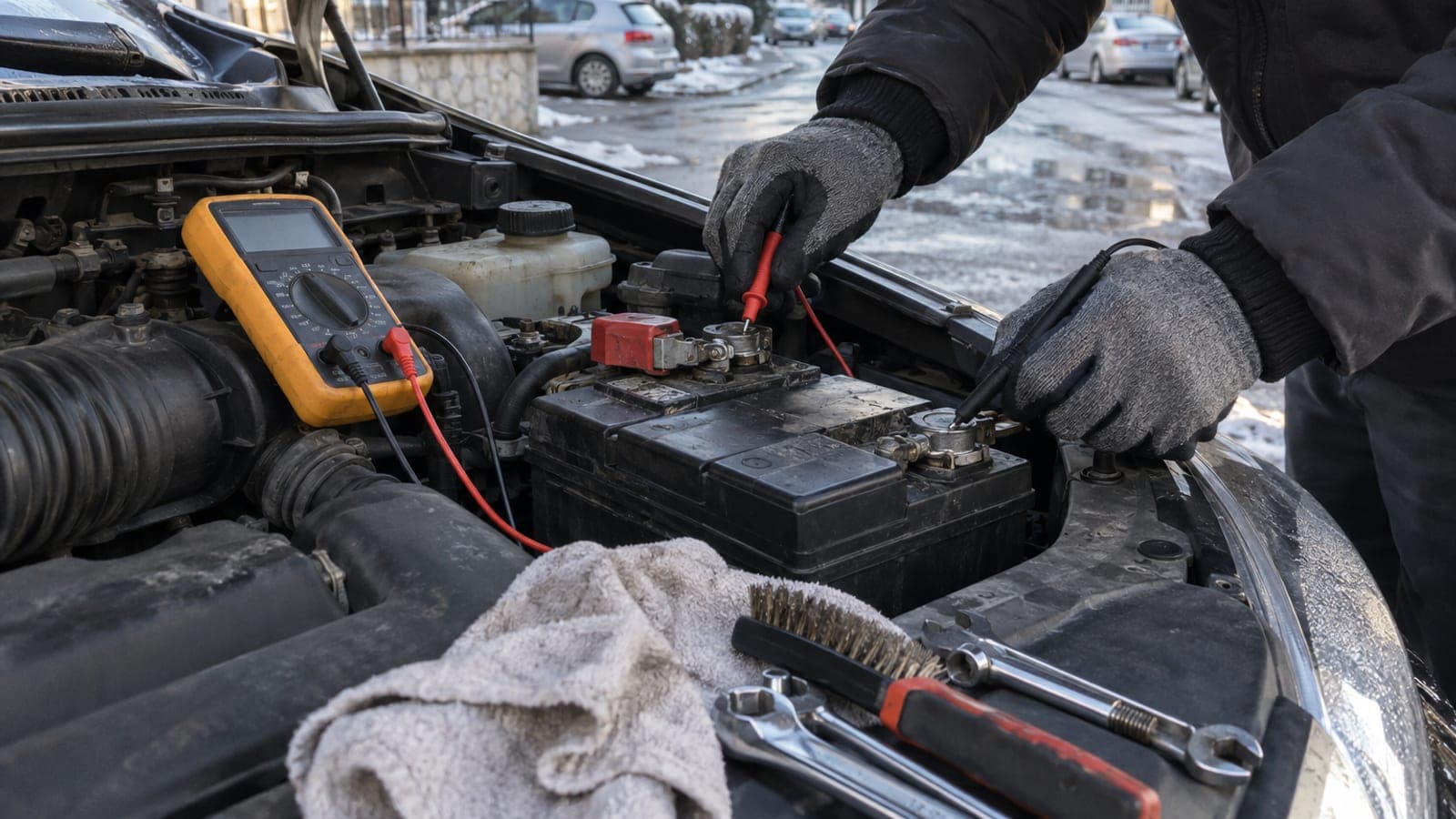
Leave the car unstarted for at least 4 hours, set the multimeter to DC volts (V⎓) and touch the red probe to (+), black to (−). 12.6 V or more is healthy, 12.4 V is about 75 percent, under 12.2 V is weak, under 12.0 V is nearly flat. If the reading falls below 9.6 V while cranking, the battery will not survive winter and should be replaced.
What you need
Step by step
Let the engine cool
Measure only after the car has sat unstarted for at least 4 hours, ideally overnight. Surface charge right after driving reads 0.2-0.4 V high, so a weak battery looks healthy. Switch the ignition fully off and keep headlights and stereo off.
Open the hood and inspect the terminals
Pull the hood release in the driver's footwell and lift the safety catch behind the grille. Look for white-blue powder on the posts (sulfation), cracked cables, and any swelling or leaking on the case. A swollen or leaking battery is not measured, it is replaced.
Clean and tighten the terminals
Put on gloves and glasses, then loosen the negative (−) cable first with a 10 mm or 13 mm spanner, followed by the positive (+). Scrub the corrosion off with a wire brush dipped in the baking soda solution and dry it. Refit in reverse order, positive first, snug the nuts so nothing moves by hand, and add a thin film of grease.
Measure the resting voltage
Set the multimeter to V⎓ (DC volts) on the 20 V range and press the red probe on the (+) post and the black probe on the (−) post. 12.6-12.8 V is fully charged, 12.4 V is 75 percent, 12.2 V is 50 percent, and 12.0 V or lower means under 25 percent. Note the value on your phone.
Measure the drop while cranking
With the probes still on the posts, ask someone to turn the key and start the engine while you watch the display for 2-3 seconds. The reading should stay above 10 V during cranking. If it dips below 9.6 V the battery collapses under load and will not start on a cold winter morning.
Check the charging voltage
Repeat the same measurement with the engine idling: 13.8-14.7 V is normal. Below 13.2 V points to a weak alternator or regulator, above 15 V means overcharging. Both will kill the battery over winter and need a workshop visit.
Read the battery age and label
The label on top carries a production date or code; a battery older than 4 years is a risk heading into winter. Note the Ah and CCA/EN ratings too, because a replacement should match or exceed the CCA figure.
Charge or replace if it tests weak
If you measured between 11.8 and 12.4 V, charge it with a smart charger for 8-12 hours, rest it 4 hours and measure again. If it will not climb above 12.5 V, the battery is done. Battery shops and dealers usually run a free load test that reports a state-of-health percentage.
Tips
Watch out
Batteries vent hydrogen gas and the sulfuric acid inside burns skin. Never let a metal wrench bridge both terminals; the short-circuit spark can cause an explosion. Disconnect the negative (−) first and reconnect the positive (+) first. On some cars, removing the battery resets the radio code, window memory and clock. Never touch a swollen or leaking battery, call a service instead.
Frequently asked questions
+I don't have a multimeter, how can I judge my battery?
Slow, labored cranking, headlights dimming at idle, and the battery icon lighting up on the dash all point to a weak battery. Battery shops and dealers usually run a free load test that takes about 5 minutes.
+I measured 12.4 volts, do I need a new battery?
No, 12.4 V means roughly 75 percent charged. Take a long drive or charge it overnight with a smart charger and measure again; if it reaches 12.6 V the battery will get through winter.
+How often should a car battery be replaced?
Typically every 4-5 years in Turkish conditions. Short trips, very hot summers and frequent jump starts can cut that down to 2-3 years.
+Does a car that starts on jumper cables still need a new battery?
A jump start only gets you going, it does not repair the battery. After a jump, drive at least 40 minutes without stopping, then measure; if it stays below 12.4 V the battery needs replacing.
+What does a battery check cost at a workshop?
Most battery dealers test the battery and clean the terminals free of charge. At authorized service centers, the battery and charging system check is usually part of the scheduled maintenance package.
Sources and verification
Last verified: 13 Eylül 2026. tell us. Prices and typical battery lifespans reflect Turkish market conditions.
This content is for information only; for official procedures the relevant institution’s current announcements take precedence. Details: disclaimer.