How do you set tire pressure correctly?
Read the correct figure off the door-jamb label and set cold tire pressure at the gas station air pump in about 10 minutes.
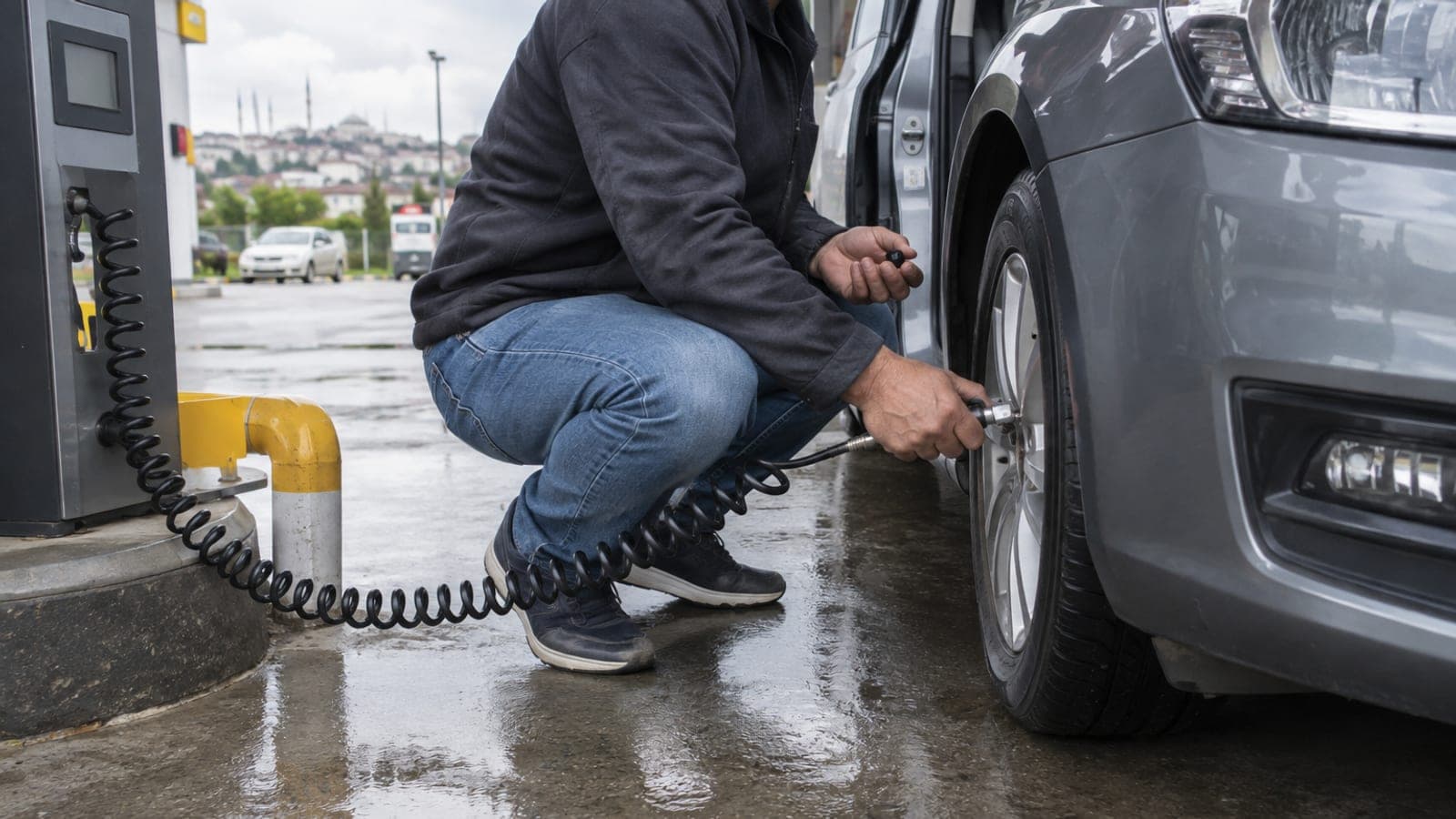
Short answer
Read the front and rear psi or bar figure from the label on the driver's door jamb. With the car driven no more than 2 miles and the tires cold, remove the valve cap, press the air hose head onto the valve, dial the target with the + / - buttons and wait for the beep. Do all four tires one by one, check the spare, and refit the caps.
What you need
Step by step
Find the correct pressure figure
Open the driver's door and look at the yellow-white label on the jamb near the B-pillar. It lists values like "Front: 2.2 bar / 32 psi, Rear: 2.0 bar / 29 psi" plus a separate line for full load. No label? Check the "Specifications" or "Tires" section of the manual, or inside the fuel filler flap. The "MAX 44 PSI" molded on the sidewall is a limit, not a target.
Measure the tires cold
Check after the car has sat at least three hours, or after driving no more than 2 miles. A hot tire reads 0.2-0.4 bar high, so bleeding air to match the label leaves it underinflated. If you just came off the highway, wait 20-30 minutes at the station or accept a target 0.3 bar above the label while warm.
Set the pump to your target
Pull the hose over to the car at the air station. On digital units, enter the target with the "+" and "-" buttons; convert if the unit differs, since 1 bar equals 14.5 psi. Older analog dial pumps have a trigger to inflate and a bleed button to drop pressure. Confirm the unit shown on screen reads "BAR" or "PSI" before you start.
Add air and wait for the beep
Turn the valve cap counterclockwise, remove it and pocket it. Press the hose head straight down onto the valve stem; a short hiss is normal and stops once it seats. An automatic pump gives a long beep when it hits the target, usually within 10-25 seconds. Pull the head off, hand-tighten the cap and move to the next tire.
Finish all four tires and the spare
Use the front figure on both front tires and the rear figure on both rears, since most cars specify different values. Check the spare in the trunk too; it often needs 2.8-4.2 bar and has its own line on the label. Narrow temporary "donut" spares take the higher end of that range.
Adjust for a heavy load
Heading off on vacation with four or five people and a full trunk, use the "full load" line on the label, which is typically 0.2-0.4 bar above normal. Drop back to the normal figure when you return. Reset pressures after a summer-to-winter tire swap as well, because tires lose air sitting on the storage rack.
Reset the TPMS warning
On cars with pressure sensors, go to "Vehicle Settings" or "Service" in the instrument display, select "Tire Pressure Reset / TPMS Reset" and hold OK. Some models use a SET button under the dashboard, held for three seconds with the ignition on. If the light stays on, driving 10-15 minutes at low speed lets the sensors relearn.
Repeat once a month
Tires normally lose about 0.1 bar a month, and pressure drops another 0.1 bar for every 10 °C the weather cools. Set a monthly reminder on your phone and check tread depth at the same time: if a coin dropped in the groove shows its full outer rim, the tread is near the 1.6 mm legal limit.
Tips
Watch out
Mistaking the "MAX PRESS 44 PSI" figure on the sidewall for the target pressure is the most common error; that number is the tire's structural limit, not what the car needs. Never bleed air out of a hot tire either, since pressure will fall to a dangerous level once it cools.
Frequently asked questions
+Should tire pressure be in bar or psi?
Both measure the same thing in different units: 1 bar equals 14.5 psi. If the label says 2.2 bar, you enter 32 psi on the air pump.
+Do gas stations charge for air?
At most stations air and water are free. Some machines run on a token you pick up inside the shop, so ask an attendant if the pump does not start.
+The TPMS light came on, do I need a tire shop right away?
Check all four tires at the nearest station first; usually one is down 0.3-0.5 bar and the light clears after you add air. If it returns even though the tire holds pressure, have it inspected for a nail or leak.
+Do I need to raise pressure in winter?
Pressure drops roughly 0.1 bar for every 10 °C the temperature falls, so check more often in cold weather. You do not need to exceed the label figure, just maintain it.
+How often should I check?
Once a month and before every long trip. A normal tire loses about 0.1 bar a month, so three months without a check leaves a serious shortfall you cannot see by eye.
Sources and verification
Last verified: 13 Eylül 2026. tell us. Prices converted to approximate US dollar equivalents; tread depth limit of 1.6 mm follows EU rules, US minimum is 2/32 inch.
This content is for information only; for official procedures the relevant institution’s current announcements take precedence. Details: disclaimer.