How do you brew Turkish coffee with thick foam?
Correct measuring, the lowest possible heat and a single stir are all you need for lasting foam in a cezve.
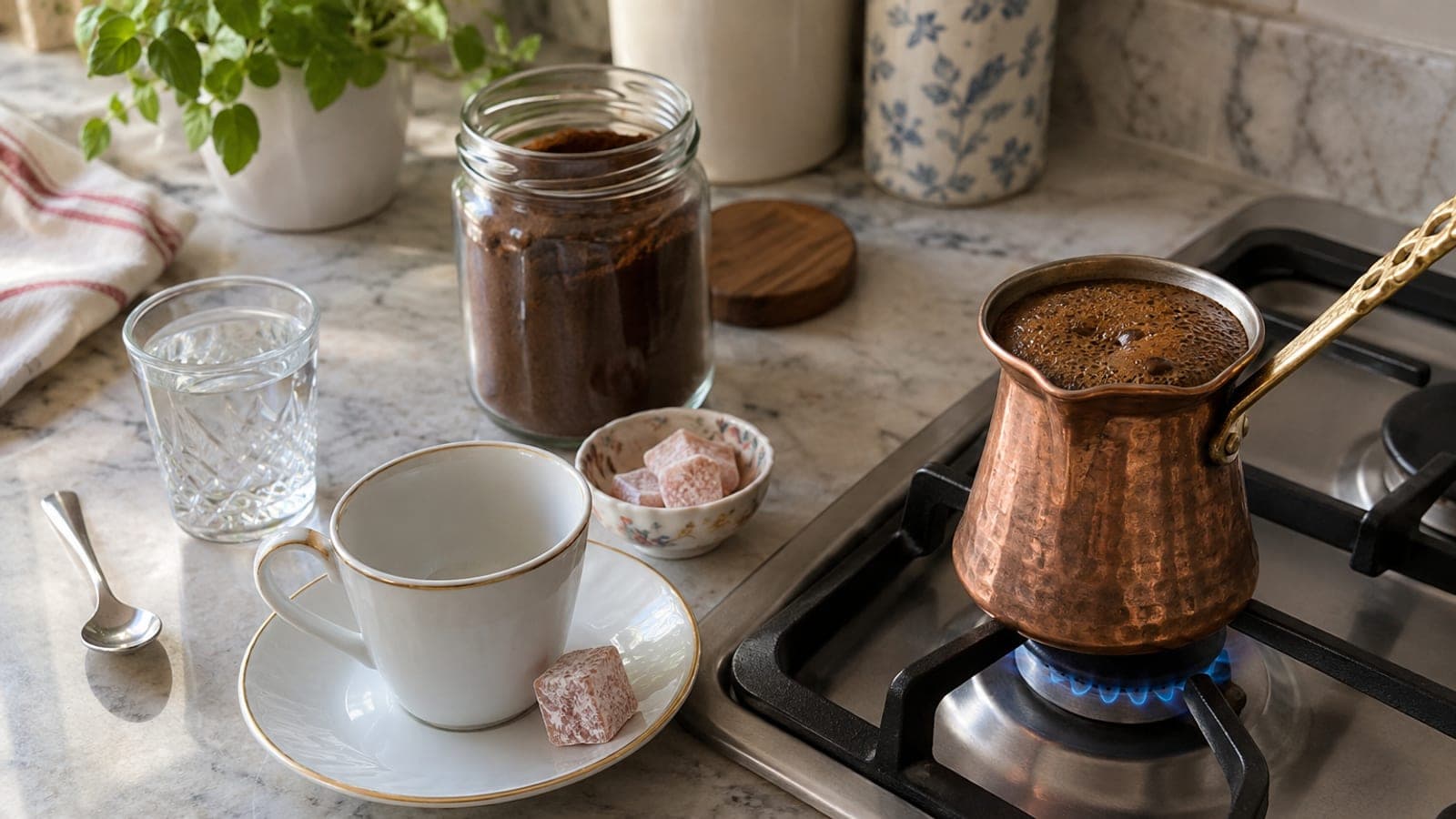
Short answer
Add 1 level dessert spoon (6-7 g) of coffee to 1 cup (about 70 ml) of cold water and stir well before it goes on the stove. Heat on the lowest setting for 3-4 minutes without stirring. When the foam rises near the rim, take the pot off the heat, spoon the foam into the cups, return the pot for 8-10 seconds, then pour the rest slowly down the inside of the cup. Never let it boil.
What you need
Step by step
Measure the water with the cup
Fill the cup you will drink from to the brim with cold water (about 70 ml) and pour it into the cezve. Measuring with the cup matters: too much water thins the foam and breaks it up, too little scorches the coffee on the bottom.
Add the coffee and sugar
Spoon 1 level dessert spoon (6-7 g) of freshly ground Turkish coffee onto the water for each cup. Add sugar now if you want it: none for plain, 1 cube for medium, 2 cubes for sweet. Sugar dropped in during brewing collapses the foam.
Stir before it hits the heat
While the cezve is still cold, stir the coffee and sugar with the dessert spoon for 20-30 seconds until no lumps remain. Coffee dissolved in cold water forms one continuous foam layer as it heats; stirring while hot splits that layer apart.
Wait on the lowest heat
Set the cezve on the smallest burner and keep the heat at its lowest setting (1-2 on a 9-level stove, 3-4 on induction). This stage should take 3-4 minutes. Do not put the spoon back in; fine bubbles appear first, then a velvety thick foam.
Share the foam between cups
When the foam climbs to within 1-2 centimetres of the rim, just before it boils, lift the cezve off the heat. Skim the top of the foam with the dessert spoon and divide it evenly between the cups. This step decides how thick the foam in each cup will be.
Do the final rise and pour
Return the cezve to the same low heat for 8-10 seconds and remove it the moment the first rise shows. Pour the remaining coffee slowly down the inner wall of the cup in one motion; pouring fast into the middle flattens the foam already there.
Let it settle and serve
Leave the cup still for 30-60 seconds so the grounds sink to the bottom. Serve with a glass of cold water and Turkish delight. Take the first sip through the foam and do not stir with a spoon.
Tips
Watch out
The most common mistake is boiling the coffee: once it bubbles hard the foam collapses, the taste turns bitter and grounds end up in the cup. Sweetened coffee that boils over leaves a sticky layer on the stove, and the splashes burn your hand. If the handle is metal, always use a holder or cloth, and keep the cezve away from your body as you lift it off the heat.
Frequently asked questions
+Why is no foam forming at all?
Usually one of three reasons: the heat is too high, the coffee is stale, or you started with hot water. Begin with cold water, give it the full 3-4 minutes on the lowest heat, and do not stir while it brews.
+When should I add the sugar?
Before the cezve goes on the stove, together with the cold water. Sugar tossed in mid-brew kills the foam instantly and makes the coffee scorch on the bottom.
+Can an electric Turkish coffee maker produce foam?
Yes. Fill the reservoir with cold water measured by the cup, add the coffee and sugar and stir, then start the machine's Turkish coffee program and pour as soon as it finishes.
+How many cups can I brew in one cezve?
Only as many as keep the water below two thirds of the pot: 1-2 cups in a 2-cup cezve, at most 3 cups in a 4-cup cezve. More than that boils over and ruins the foam.
+How long does the foam last in the cup?
Properly brewed coffee holds its foam for 3-5 minutes. Not shaking the cup and not stirring with a spoon stretches that time.
Sources and verification
Published: September 12, 2026. tell us. Translated from Turkish; measurements use the standard Turkish coffee cup (about 70 ml).
This content is for information only; for official procedures the relevant institution’s current announcements take precedence. Details: disclaimer.