How do you save energy at home?
A weekend-sized savings plan: read the bill, dial in the boiler, seal the gaps, and switch to Eco cycles on your own.
Short answer
Find your real unit cost by dividing your bill total by the "Active Energy Consumption (kWh)" line. Set boiler heating water to 55-60 °C, tap water to 45-50 °C, and the room thermostat to 20 °C. Renew window and door seals, use "Eco 40-60" for laundry and "Eco 50" for dishes, fit LED bulbs, and cut the TV-modem group at a switched socket.
What you need
Step by step
Read the bill and work out your kWh cost
Find the "Active Energy Consumption (kWh)" line on your electricity bill. Divide the total amount payable by that kWh figure; the result is your true unit cost, including distribution fees, the energy fund, consumption tax and VAT. Without this number you cannot tell what any saving is worth in money.
Switch to the three-period tariff
On your retail supplier's website follow "Customer Services > Subscription > Tariff Change". On the three-period tariff, 22:00-06:00 is cheapest and the 17:00-22:00 peak is most expensive. It pays off if you can move laundry, dishes and the water heater to night hours, and your meter must support multi-period metering.
Set the boiler to the right temperatures
Turn the radiator-symbol dial on the boiler panel to 55-60 °C and the tap-symbol dial to 45-50 °C. Keep the "Summer/Winter" switch on Summer from April to October. Set the room thermostat to 20-21 °C by day and 17 °C at night or when the house is empty; every 1 °C drop cuts heating use by roughly 5-6%.
Renew the window and door seals
Wipe the sash frame with a damp soapy cloth and dry it, then pick a D profile (2-4 mm gap) or E profile (3-5 mm gap) EPDM seal, cut it to length and press the adhesive side into place. Screw a 90 cm brush strip under the exterior door. Sealing a whole flat takes about one to two hours.
Bleed the radiators and add reflectors
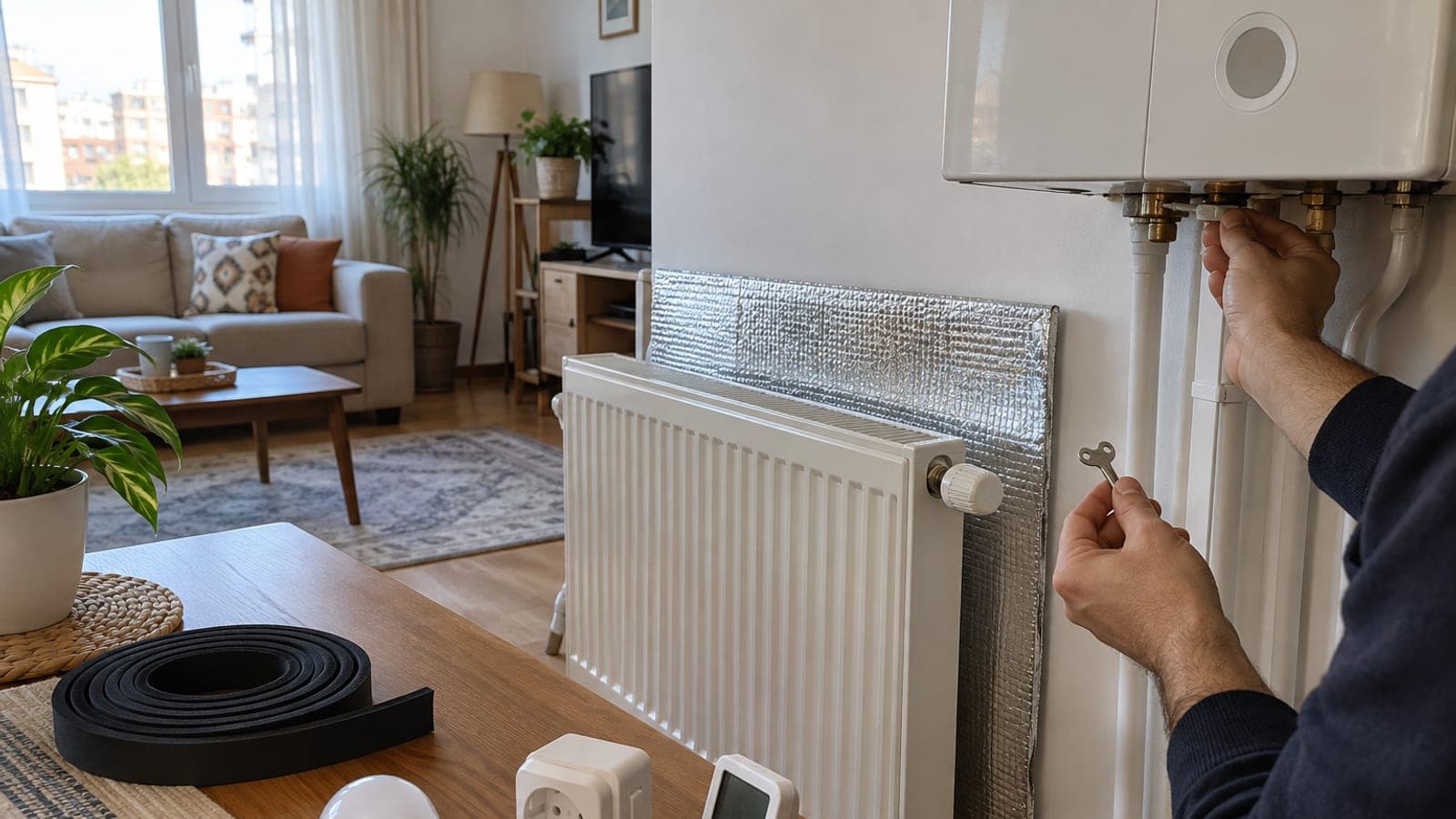
With the boiler off and the radiators cold, open the bleed screw at the top corner half a turn with the key; wait until water appears, then close it. Top the boiler manometer back up to 1.5 bar. Fit foil reflector panels behind radiators on exterior walls so heat is not pushed into the wall.
Move appliances to Eco cycles
Use "Eco 40-60" instead of the 60 °C cotton wash, and "Eco 50 °C" in the dishwasher; both cut consumption clearly when run fully loaded. Set the fridge to 4 °C and the freezer to -18 °C, and leave at least 5-10 cm of clearance behind the fridge for airflow.
Change the lighting to LED
Remove any remaining incandescent and halogen bulbs. Replace a 60 W bulb with 806 lumens / 8-9 W and a 40 W bulb with 470 lumens / 5-6 W. In the living room and kitchen, 3000-4000 K colour temperature is plenty. Start with the five or six fittings you use most; payback is usually a few months.
Cut the stand-by loads
Gather the TV, sound system, games console and charger bricks onto one switched socket and flip it off before bed. Left permanently on, that group can waste 100-200 kWh a year. Keep the modem separate; if you want it off, use the night mode in its app instead.
Tips
Watch out
In homes with a flued boiler, instant water heater or stove, sealing the place completely airtight can let carbon monoxide build up. Never block the air vents in the wall, and keep fresh air reaching the room with the flued appliance. When you leave for a long stretch in winter, do not shut the boiler down entirely; frost protection only works while electricity and gas are on.
Frequently asked questions
+How does the tiered electricity tariff affect savings?
Residential customers get a subsidised lower tier up to a monthly kWh threshold, with a pricier tier above it. Staying under the threshold cuts your unit price significantly; check the current limit in the tariff table published by EPDK.
+Is it cheaper to turn the boiler down and up, or hold a steady low temperature?
A steady low temperature is cheaper. Letting the house go cold and reheating it runs the boiler at full output for a long stretch; holding the thermostat at 17 °C overnight and 20-21 °C by day uses less gas.
+Can I fit the seals myself?
Yes. Self-adhesive EPDM seal is cut with scissors and pressed on by hand, no tools needed. Just make sure the surface is clean and dry and pick the right profile thickness so the sash still closes easily.
+How do I know the savings are working?
Note the meter reading on the same day each month and compare it with the kWh on your bill. Comparing two billing periods with similar weather lets you separate a real change from normal fluctuation.
+Which step pays back fastest?
Boiler temperature settings and a thermostat schedule show up on the first bill and cost nothing. Seals and LED bulbs come next; both typically pay for themselves within a single heating season.
Sources and verification
Last verified: 13 Eylül 2026. tell us. Prices, tariff periods and the tiered threshold refer to Turkey; verify current figures with your retail supplier and the EPDK tariff tables.
This content is for information only; for official procedures the relevant institution’s current announcements take precedence. Details: disclaimer.