How do you set up dual monitors at home?
From picking the right cable to Windows display settings, get a second monitor running in 30-45 minutes.
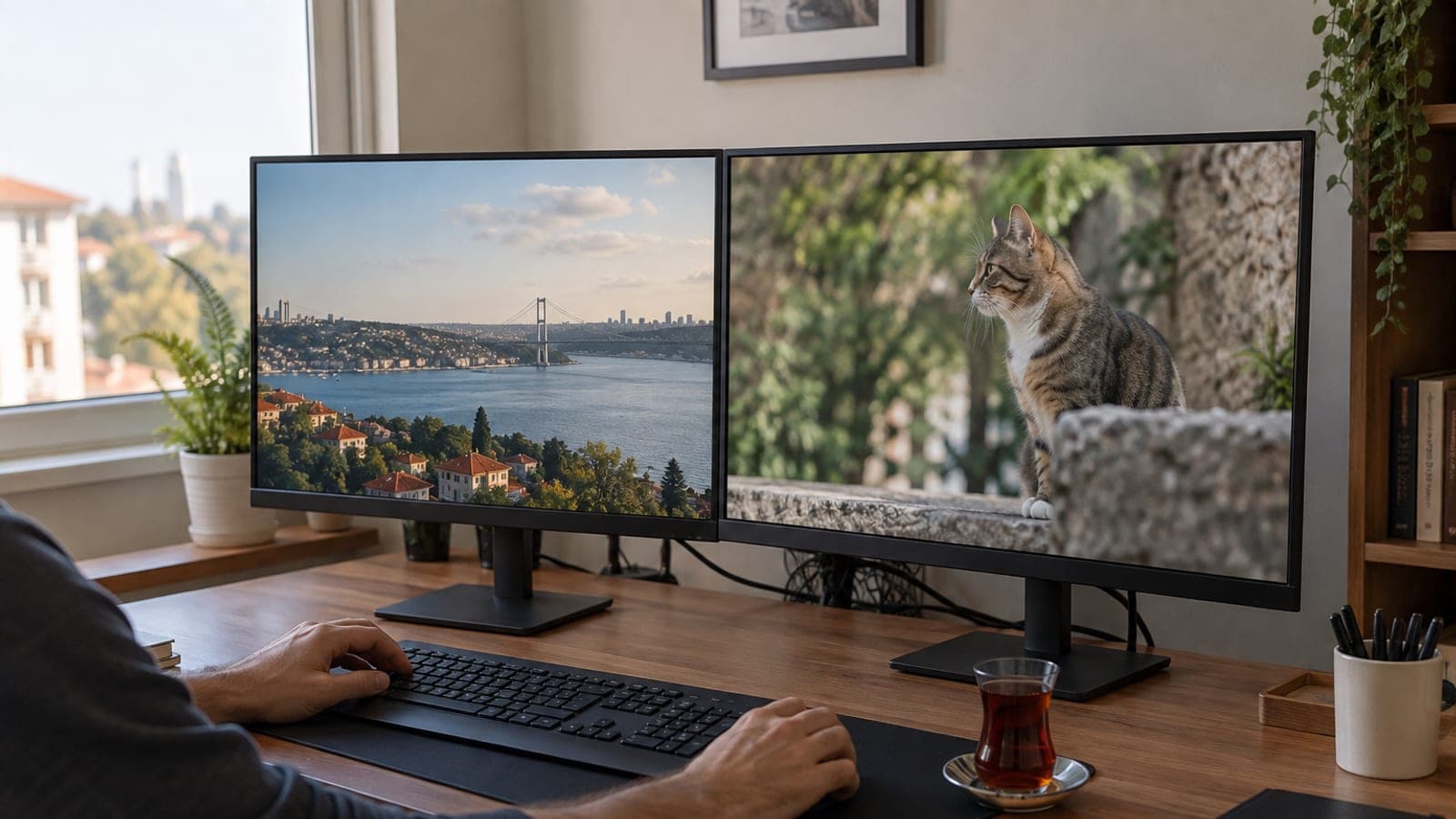
Short answer
Plug the second monitor into a free video output (HDMI or DisplayPort), power it on, then right-click the desktop and open Display settings. Under Multiple displays choose "Extend these displays", drag the numbered boxes to match how the screens sit on your desk, set each display's Display resolution and Refresh rate to the highest supported value, and click Keep changes.
What you need
Step by step
Check your outputs and cable
Count the video ports on the back of the computer. On a desktop, use the HDMI and DisplayPort connectors on the graphics card, not the ones on the motherboard. If a laptop has no HDMI, confirm on the manufacturer's page that its USB-C port supports DisplayPort Alt Mode. For 1440p at 144 Hz, buy a DisplayPort 1.4 cable instead of HDMI 2.0.
Assemble and connect the monitor
Unbox the monitor, attach the stand with a Phillips screwdriver, and place it on the desk. Connect the power adapter first, then the video cable to the computer; the PC does not need to be off while you plug it in. Press the monitor's power button to switch it on.
Select the correct input
If the screen shows "No Signal", press the joystick or Menu button on the bottom or back of the monitor and pick the input you cabled from the Input Source menu: HDMI 1, HDMI 2 or DisplayPort. Most monitors ship with Auto Source Detect turned off, so manual selection is required.
Extend the displays in Windows
Right-click an empty spot on the desktop and open Display settings. Below the boxes labelled 1 and 2, choose "Extend these displays" from the Multiple displays drop-down, then click Keep changes in the prompt. If you are unsure which box is which screen, press Identify.
Arrange layout and pick the main display
Drag the display boxes so they match the real positions on your desk, side by side or stacked, since the mouse crosses at those edges. Select the screen where you want the taskbar and new windows to appear, then tick "Make this my main display".
Set resolution, refresh rate and scaling
Select each display in turn and set Display resolution to the (Recommended) value. Under Advanced display settings > Choose a refresh rate, pick the highest rate the monitor supports (60, 75 or 144 Hz). If text sizes do not match between differently sized screens, adjust Scale between 100% and 150%.
Fix the physical setup and test
Line up the top edges of both screens and place them 5-8 cm below eye level, with a viewing distance of 60-70 cm for a 24 inch panel. Send a window across with Windows key + Shift + Right arrow to test the handoff, then tidy the cables with hook-and-loop straps.
Tips
Watch out
Cheap passive HDMI-to-DisplayPort converters only work in one direction and usually show nothing at all; if the direction is wrong you need an active converter. Cheap HDMI cables longer than 5 metres also cause flicker or a black screen at 1440p and above, so use a certified cable.
Frequently asked questions
+Do I need a new graphics card for two monitors?
Usually no. Almost every graphics card and integrated GPU made after 2015 drives at least two displays, as long as the computer has two separate video outputs.
+My second screen is not detected, what should I do?
Pick the correct input in the monitor's Input Source menu, unplug and reseat both ends of the cable, then press Detect under Display settings > Multiple displays. If it persists, update the graphics driver from the manufacturer's site.
+Do both monitors have to be the same brand and size?
No, mixed brands and sizes work fine together. If the resolutions differ, you just need to set the scaling value separately for each display.
+How do I connect two external monitors to a laptop?
Run one screen from HDMI and the other from a USB-C/Thunderbolt port using an adapter that supports DisplayPort Alt Mode. With only one port, you need a USB dock with a DisplayLink chip.
+Why is it hard to move the mouse between screens?
The boxes in Display settings do not match the real positions on your desk. Drag them so their top edges line up and leave no gaps between them.
Sources and verification
Last verified: September 15, 2026. tell us. Menu names follow Windows 11 English UI labels.
This content is for information only; for official procedures the relevant institution’s current announcements take precedence. Details: disclaimer.