How do you find and seal heat leaks at home before winter?
With a candle, a thermometer and about 300 lira of supplies, close up window, door and shutter box leaks in one weekend.
Short answer
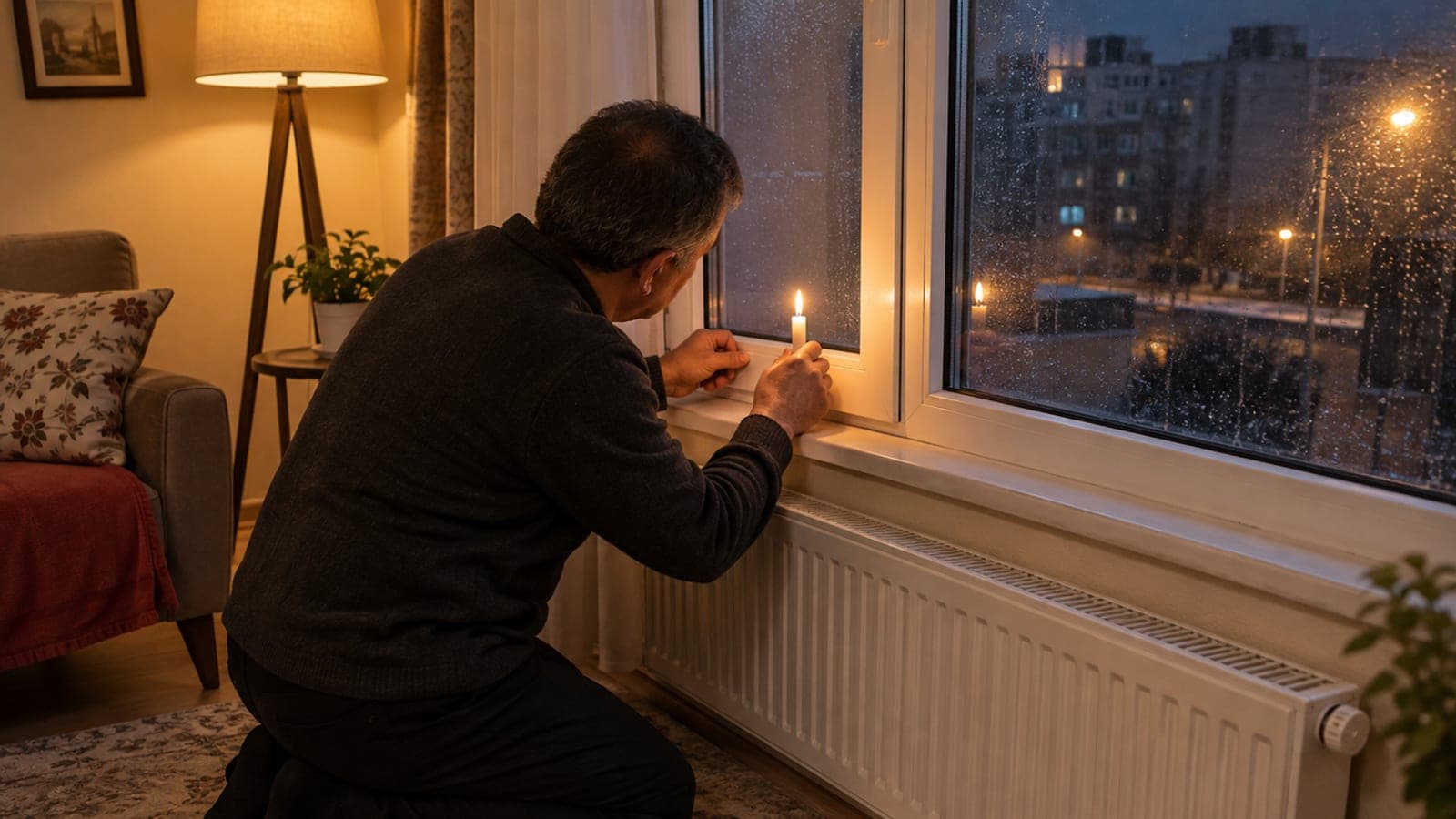
To find leaks, warm the house, close every window, run the kitchen extractor hood and move a lit candle along the frame edges: a flickering flame means air is coming in. Fit self-adhesive D or P profile EPDM tape to window sashes, a brush strip under doors, 20 mm XPS board inside the roller shutter box and aluminium foil behind radiators. Materials cost 250-500 lira and the job takes 4-6 hours.
What you need
Step by step
Create a temperature gap
Two hours before the leak test, run the boiler at its normal setting and bring the indoor temperature to 21-22 C. You need at least an 8-10 degree difference with the outside air, otherwise the air movement is too weak to feel. Pick a cool, windy evening for the test.
Put the home under negative pressure
Close all windows and exterior doors, leave interior doors open. Run the kitchen extractor hood on its highest setting together with the bathroom fan; the home goes into a slight vacuum and pulls outside air inward. If you have a flue-type combi boiler or water heater, switch the appliance off for this step.
Hunt for leaks with a candle
Move the lit candle or incense stick slowly, about 5 cm away, along the gap between sash and frame, on the lock side, at the hinges, under doors, around socket and switch boxes, at the shutter box cover and at the air conditioner pipe hole. Where the flame or smoke pulls inward, mark the spot with masking tape. Scanning one flat takes 30-45 minutes.
Confirm cold surfaces with a thermometer
Point the infrared thermometer at the middle of the wall, the window edge, the outside corner and the shutter box cover, and note each reading. Any surface more than 3 degrees colder than the middle of the wall has missing insulation or a thermal bridge. Mould spots and damp usually show up at the same places.
Replace window and door seals
Wipe the sash edge with alcohol and let it dry, then apply P profile tape if the frame gap is 2-3 mm or D profile if it is 4-5 mm, overlapping at 45 degrees in the corners rather than cutting. Screw the brush threshold under the door so the bristles touch the floor by 2-3 mm. Each window takes 10-15 minutes, a door about 20.
Close the shutter box and pipe holes
Remove the inner cover of the roller shutter box, cut 20 mm XPS board to size and glue it to the inside faces, then fit a brush grommet around the strap slot. Fill the gap around air conditioner and flue pipes with polyurethane foam, trim the excess and run sealant over it. These two points are usually the biggest leaks in the flat.
Line the wall behind radiators with foil
There is no need to remove the radiator. Cut the aluminium-faced foil to the height of the radiator and stick it to the wall with the shiny side facing the room. Leave at least 2 cm of air gap between the panel and the foil. On radiators mounted against an exterior wall this noticeably cuts the loss.
Plan ventilation after sealing
Once sealed, the home takes in less air, so humidity rises. Twice a day, morning and evening, open opposite windows for 5-10 minutes for a burst of cross ventilation and turn the heating down while you do it. Run the bathroom and kitchen fans for 15 minutes after showering or cooking.
Tips
Watch out
In homes with a flue-type combi boiler, water heater or stove, closing off every air inlet can cause flue gases to back up and lead to carbon monoxide poisoning. Never block the air vent in the appliance room, fit a carbon monoxide detector, and run the extractor-hood leak test only with the appliance switched off.
Frequently asked questions
+Do I need to rent a thermal camera to find heat leaks?
No. The candle test plus an infrared thermometer costing 300-600 lira will find most leaks. A thermal camera is more useful for in-wall insulation and thermal bridges at building scale.
+What does this cost, and how much will I save on the bill?
For one flat, seals, a brush threshold, XPS and foil total roughly 250-500 lira. If the leaks were significant, expect gas use to drop by 5-15 percent; the exact figure depends on the age of the home and the glazing.
+Does clear shrink-film window insulation actually work?
It works on single-glazed windows you do not use, since it traps a still layer of air against the glass. But the window cannot be opened all winter, and on double glazing the gain is negligible.
+Is this enough without exterior wall insulation?
Sealing air leaks improves comfort immediately but does not stop heat conducted through the walls. If the wall surface is 4-5 degrees colder than the room air, the real fix is interior or exterior insulation.
+Will sealing cause mould and damp in the house?
It can if you do not ventilate. Two bursts of 5-10 minute cross ventilation a day, plus running the bathroom fan for 15 minutes after a shower, keeps humidity in the 50-60 percent range.
Sources and verification
Published: September 12, 2026. tell us. Prices are in Turkish lira and the setup assumes a typical Turkish apartment, where roller shutter boxes and flue-type combi boilers are common.
This content is for information only; for official procedures the relevant institution’s current announcements take precedence. Details: disclaimer.