How do you brew coffee at home with French press, V60 or moka pot?
Follow the grams, degrees and minutes for French press, V60 and moka pot in order and brew consistent coffee at home.
Short answer
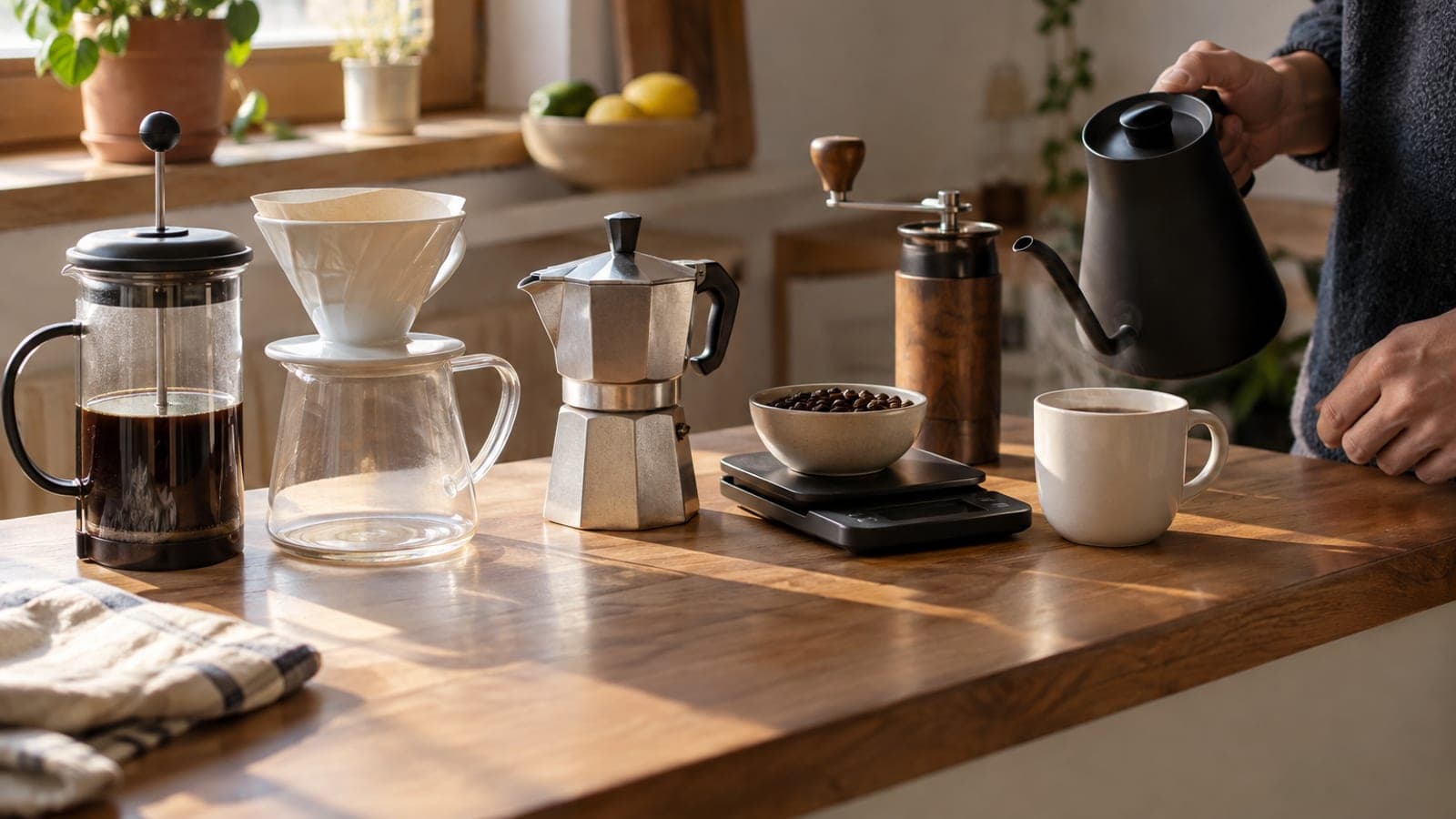
Baseline ratio: 1 g coffee to 16 g water. French press: 30 g coarse grind + 480 g water at 93 °C, wait 4 minutes, press down over 10 seconds. V60: 15 g medium-fine + 250 g water; bloom with the first 30 g for 30 seconds, total 2:30-3:00. Moka pot: fill the base with hot water up to the valve, brew on low heat, and pull it off when the sound turns to a sputter.
What you need
Step by step
Pick your method
Choose French press for daily convenience and full body, V60 for a clean and aromatic cup, moka pot for a small, dark serving. Stay with one method for the first week; learning all three at once mixes up the variables. Move to the second one only after your results are consistent.
Grind for the method you chose
Grind coarse sea salt size for French press, between fine sand and granulated sugar for V60, and slightly finer than V60 for the moka pot. On a Timemore C2, close the nut all the way and count from zero: 24-26 clicks for French press, 18-20 for V60, 14-16 for moka pot. On a Baratza Encore, set the dial to 28-30 for French press and 18-20 for V60.
Bring the water to 93 degrees
On a temperature-controlled kettle, select 93 °C with the + and − buttons and press START. Without one, boil the water, leave the lid open and wait 45 seconds; that pause lands you around 93-95 °C. Boiling water scorches the extraction and leaves a bitter taste.
Weigh the coffee and the water
Turn the scale on, place the vessel on it and press TARE to zero out. For a 1:16 ratio, 15 g of coffee takes 240 g of water and 30 g takes 480 g. Eyeballing with a spoon creates a 2-3 gram swing from cup to cup, so weigh every brew.
Brew with the French press
Add 30 g of coarse grounds, pour all 480 g of water from above in one go and start the timer. At 1 minute, break the crust on top with a spoon, fit the lid but leave the plunger alone. At 4 minutes, press down slowly over 10 seconds and decant the coffee into another carafe right away; coffee left on the grounds turns bitter.
Brew with the V60
Seat the paper filter in the dripper, rinse it with hot water and discard the water underneath. Spread 15 g of coffee in a flat bed, wet it with 30 g of water and let it bloom for 30 seconds. Then pour in 60 g pulses in circles up to 250 g total; the whole drawdown should finish between 2:30 and 3:00.
Brew with the moka pot
Fill the base with 70 °C water up to the lower edge of the safety valve, seat the funnel, fill it with coffee level and untamped, then wipe off the excess. Brew on low to medium heat with the lid open. When the stream turns honey-colored and the sound becomes a sputter, take it off the heat and set the base on a damp cloth.
Adjust one variable by taste
If the cup is sour, salty and thin-bodied, it is under-extracted: grind 2 clicks finer or raise the water by 2 °C. If it is bitter, dry and puckering, it is over-extracted: grind 2 clicks coarser or cut 30 seconds off the French press time. Change only one variable per brew and write it down.
Tips
Watch out
Never leave a moka pot on high heat and never fill it above the safety valve; if the base over-pressurizes, boiling coffee can spray out. Do not shock the hot pot with cold water either, as that loosens the metal center bolt.
Frequently asked questions
+I do not have a grinder. Can I buy pre-ground coffee?
You can, but you lose a lot of freshness. Buy a small 250 g bag, tell the shop which method you use so they grind for it, and finish it within two weeks.
+Is Turkish coffee one of these methods?
No. Turkish coffee is a separate unfiltered method brewed with powder-fine grounds. The grind settings and 1:16 ratio in this guide do not apply to it.
+Can I brew with tap water?
Yes, if your water is low in mineral hardness. In hard-water cities, a pitcher filter or bottled water noticeably reduces the flat, chalky taste in the cup.
+How many grams of coffee does one cup need?
About 12-13 g of coffee is enough for a 200 ml cup. If you want it stronger, add 1-2 g of coffee instead of increasing the water.
+What is the most affordable starter setup?
A French press with a 0.1 g scale and a hand grinder is the cheapest way in. You can add a gooseneck kettle and a V60 later.
Sources and verification
Last verified: 13 Eylül 2026. tell us. Grind click counts are calibrated for Timemore C2 and Baratza Encore; other grinders need their own dial-in. Water hardness varies by city, so check local water before relying on tap water.
This content is for information only; for official procedures the relevant institution’s current announcements take precedence. Details: disclaimer.