How do you check your engine oil level?
Measure your engine oil yourself in five minutes with the yellow-ringed dipstick, and top up correctly if it is low.
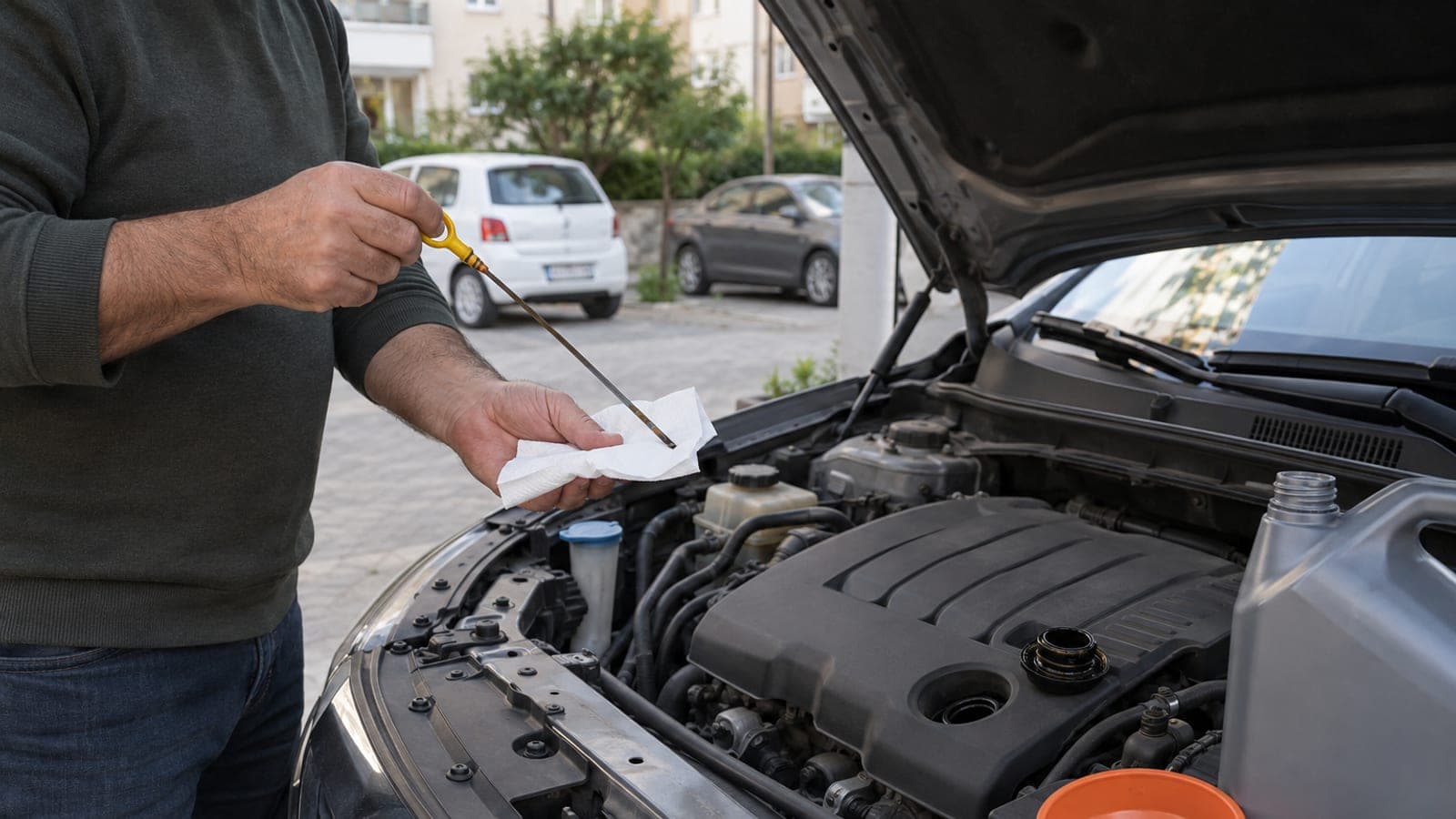
Short answer
Park on level ground, shut off the engine and wait 10 minutes. Pull the yellow-ringed dipstick, wipe it with a clean cloth, push it all the way back in and pull it again. The oil mark should sit between MIN and MAX. If it is near MIN, add oil of the same viscosity (for example 5W-30) in 200-300 ml portions and re-check after two minutes.
What you need
Step by step
Park on level ground and wait
On a ramp or a slope the reading drifts by 2-3 mm and comes out wrong. Set the parking brake and switch off the ignition. If the engine is warm, wait 10 minutes for the oil to drain back into the sump, or 15-20 minutes after a long drive.
Open the hood and find the dipstick
Pull the hood release to the left of the driver's footwell, then push the safety catch at the front center of the hood sideways and lift. On top of the engine, the stick with a yellow or orange ring and an oil-drop symbol is the dipstick. Some models label it 'ENGINE OIL'.
Pull the dipstick and wipe it clean
Grip the ring and pull the stick straight up. Wipe the bottom 8-10 cm completely with a paper towel; the first reading is unreliable because oil splashes inside the tube. Push the wiped stick all the way back in, wait two seconds, then pull it out again.
Read the MIN-MAX range
The tip has two notches, two holes or a crosshatched zone: the lower mark is MIN, the upper one MAX. The top of the oil film should sit between the two marks, ideally closer to MAX. In poor light, hold your phone flashlight behind the stick.
Check the oil's color and texture
Healthy engine oil ranges from honey to dark brown and feels slippery between your fingers. If it looks pale and frothy like milky coffee, water has mixed in; metallic glitter or gritty particles mean wear. In either case, do not top up, go to a workshop.
Top up in small amounts if it is low
The filler cap is separate from the dipstick and carries an oil-can symbol, usually with the viscosity printed on it. Turn the cap counterclockwise to open and add 200-300 ml through the funnel. Wait two minutes and measure again. Going from MIN to MAX usually takes 0.8-1 liter, so never dump a whole liter in at once.
Close up, start the engine and check the ground
Tighten the filler cap until it seats fully, press the dipstick all the way home and close the hood by dropping it from about 30 cm. Run the engine for a minute and confirm the oil pressure light goes out. Move the car and look for drips where it was parked.
Record the reading and track it
Note the date, mileage and how much you added in your phone. Checking once a month, before every long trip and once at each fuel stop is a good habit. If you lose more than 500 ml per 1,000 km, have a workshop look at it.
Tips
Watch out
Too much oil is as dangerous as too little. Above MAX the crankshaft whips the oil into foam, pressure drops, and seals and the catalytic converter suffer. If you overshoot MAX, draw the excess out through the dipstick tube with a syringe or visit a workshop. Also, opening the filler cap on a hot engine can release steam and hot oil, so never touch it without gloves.
Frequently asked questions
+Should the oil be checked hot or cold?
Either works, but stay consistent. Most manufacturers want the reading 10 minutes after shutdown; on a fully cold engine the level reads a few millimeters higher.
+Can I drive if the level is below MIN?
Risky over short distances and a firm no on a long trip. Poor lubrication wears the bearings and crankshaft. Buy a liter of the correct viscosity at the nearest station and add it before you set off.
+Which viscosity should I buy?
It is in the owner's manual and usually printed on the oil filler cap, for example 5W-30 or 0W-20. If you are unsure, give the engine code from your registration to an authorized dealer and ask.
+Does the oil light mean the level is empty?
The red oil pressure light warns about pressure, not level; if it comes on, stop somewhere safe immediately and shut the engine off. A yellow oil level warning does indicate low oil and can be fixed by topping up.
+How often should I check?
Once a month and before every long trip is enough. On cars past 100,000 km, or engines that burn oil, checking every two weeks is safer.
Sources and verification
Last verified: 13 Eylül 2026. tell us.
This content is for information only; for official procedures the relevant institution’s current announcements take precedence. Details: disclaimer.