How do you measure battery voltage and clean the terminals?
A step-by-step guide to reading resting battery voltage with a multimeter and dissolving terminal corrosion with baking soda.
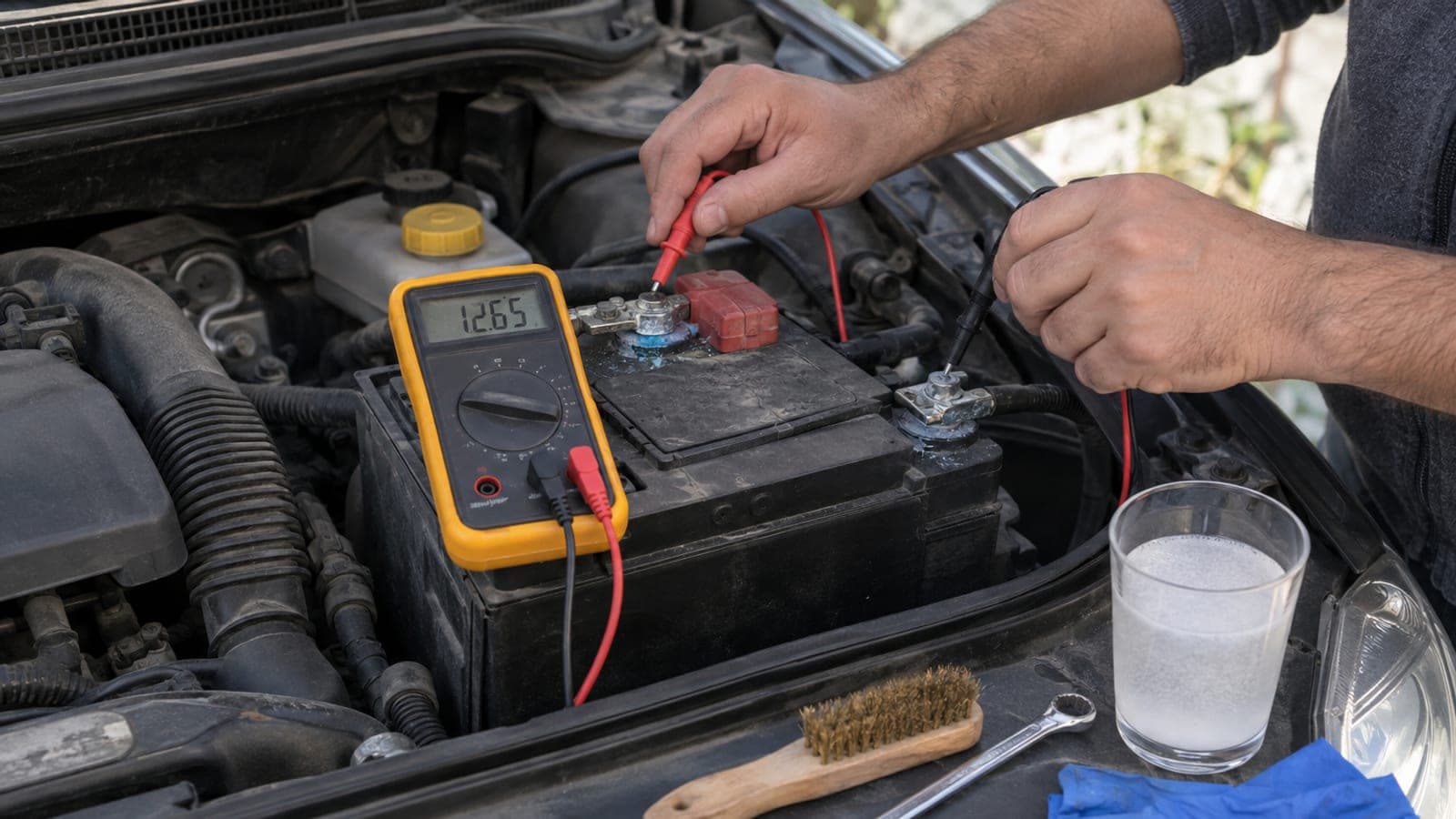
Short answer
Turn the ignition off and let the battery rest at least an hour. Set the multimeter to V⎓ (DC) 20 V, red probe on positive, black on negative. 12.6-12.8 V is full, 12.2 V is half, under 12.0 V needs charging; at idle the engine should show 13.8-14.4 V. To clean, undo the negative terminal first, scrub with baking soda solution, dry, then refit positive before negative.
What you need
Step by step
Let the battery rest
Switch off the ignition, headlights and stereo, and keep the doors shut so no interior load stays active. Wait at least an hour for a true resting reading, ideally overnight. Measure right after a drive and the alternator's surface charge gives you a misleading figure like 13 V.
Select the DC volts range
On a dial meter turn the selector to the 20 V position inside the V⎓ or DCV section. On an auto-range meter press V, and if the screen shows AC use SELECT or MODE to switch to the DC symbol. Plug the black probe into COM and the red probe into the VΩmA jack.
Read the resting voltage
Press the red probe onto the bare metal of the positive (+) post and the black probe onto the negative (-) post, and hold steady for five seconds. 12.6-12.8 V means fully charged, 12.4 V about 75 percent, 12.2 V about 50 percent, 12.0 V about 25 percent. Below 11.8 V indicates deep discharge and the battery needs a charger.
Check cranking and charging voltage
With the probes still on the posts, have a helper crank the engine; the voltage dips but should not fall below 9.6 V above 10 °C. With the engine running at idle the display should read 13.8-14.4 V. Below 13.2 V points to the alternator or its belt, above 15 V to a failed regulator.
Disconnect the terminals
Turn the ignition off and pocket the key. Loosen and lift the negative (-) clamp first with the 10 mm wrench, then remove the positive (+) clamp and refit its red plastic cover. Keep that order: pull the positive first and your wrench can short against the bodywork.
Clean with baking soda solution
Stir 1 teaspoon of baking soda into 200 ml warm water, soak a cloth and dab it on the posts and clamps; the white-green sulphate deposit fizzes away in two or three minutes. Scrub the tapered post and the inside of the clamp with the brass brush until the metal shines. Rinse with a little clean water and dry fully with a cloth.
Refit, tighten and remeasure
This time connect the positive (+) clamp first, then the negative (-), and tighten the nuts to 5-6 Nm, snug enough that the clamp will not twist by hand; overtightening cracks the lead post. Coat the outside of the joints with terminal spray or a thin film of white petroleum jelly. Measure again with the multimeter and note the value.
Tips
Watch out
A spark on top of the battery can ignite hydrogen gas: never let a wrench touch the positive post and the bodywork at the same time, and keep cigarettes away. Do not let baking soda solution get inside the cells, so keep the caps closed. Sulphuric acid burns skin and eyes; on contact rinse with plenty of water for 15 minutes and see a doctor.
Frequently asked questions
+I read 12.4 V, do I need a new battery?
No, 12.4 V is roughly 75 percent charged. Drive 30-40 minutes on the open road or use a smart charger, then remeasure; if it climbs to 12.6 V the battery is fine.
+The multimeter shows a negative number, is it broken?
No, the probes are reversed. Put red on positive and black on negative and you get the same number with a plus sign; the reading was valid either way.
+Is it safe to measure with the engine running?
Yes, but keep the probe leads clear of the cooling fan, belt and pulleys. Measure at idle with the headlights on; 13.8-14.4 V is normal.
+Can I use cola or hot water to clean the terminals?
No. Cola leaves sugar behind that invites fresh corrosion, and boiling water can deform the plastic case. Baking soda solution neutralises the acid and leaves no residue.
+How long does this take and what does it cost?
The measurement takes about five minutes and the terminal cleaning 20-30 minutes. Beyond the multimeter and brush the consumables cost very little, since baking soda and petroleum jelly are usually already at home.
Sources and verification
Last verified: 13 Eylül 2026. tell us. Voltage figures assume a 12 V lead-acid system; temperatures are in Celsius and torque in newton metres.
This content is for information only; for official procedures the relevant institution’s current announcements take precedence. Details: disclaimer.