How do you make and feed a sourdough starter?
A day-by-day schedule for building a sourdough starter from just whole wheat flour and water, ready to bake with in 7-10 days.
Short answer
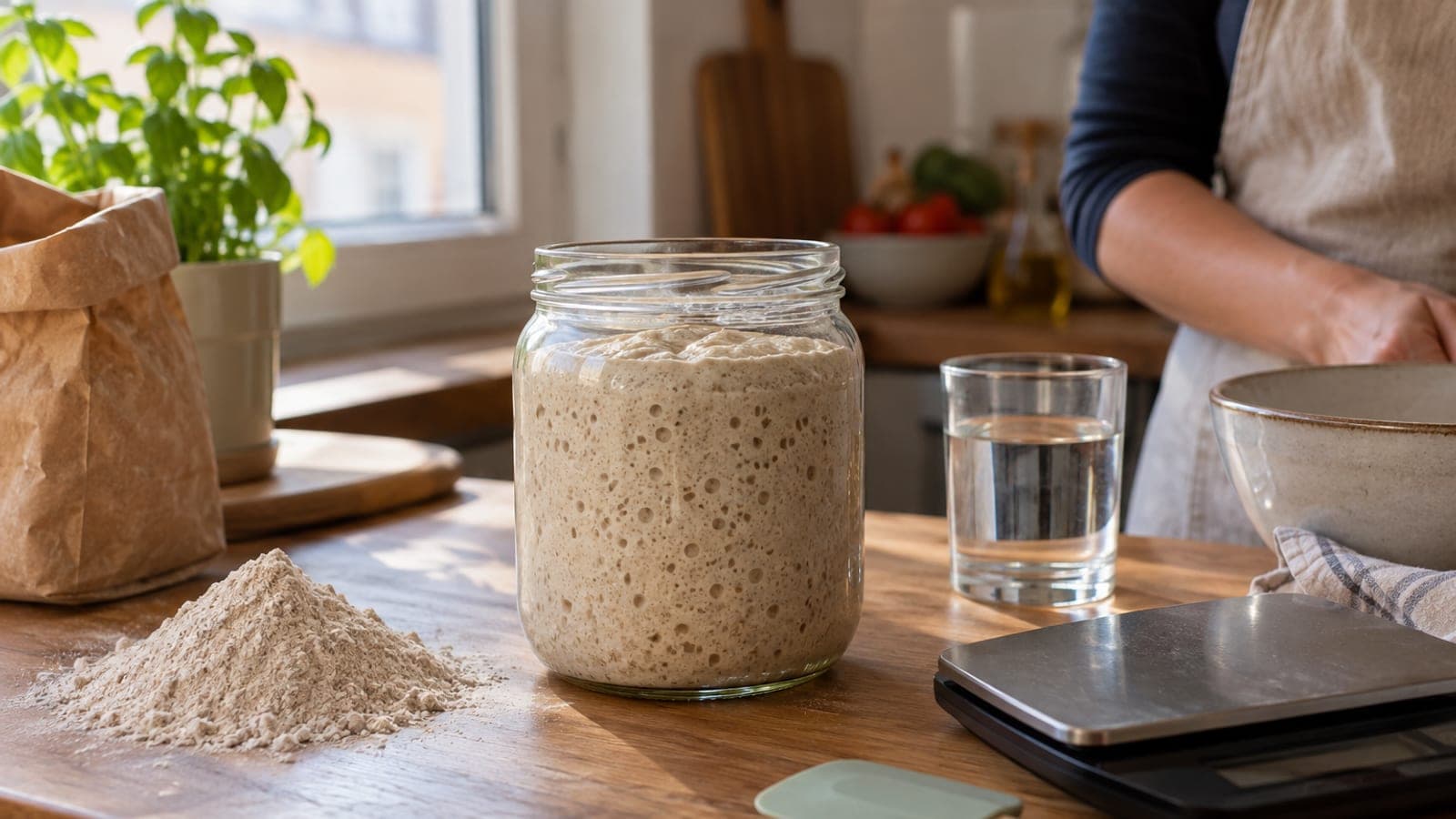
Stir 50 g whole wheat flour into 50 g room-temperature water in a glass jar, rest the lid on loosely, and keep it at 24-26 °C. From day three, keep only 50 g of the starter and feed it 50 g flour plus 50 g water every 24 hours. It is ready when it doubles and domes 4-6 hours after a feed, which usually happens between day 7 and day 10.
What you need
Step by step
Prepare the jar and water
Wash the glass jar in hot soapy water, rinse it thoroughly and dry it completely, because detergent residue will kill the young culture. Pour tap water into a pitcher and leave it uncovered for 8-12 hours so the chlorine dissipates. Aim for water at 25-28 °C when you mix.
Mix the first batch
Combine 50 g whole grain flour and 50 g water in the jar and stir until no dry lumps remain; the texture should be like thick cake batter. Mark the top of the mixture with a rubber band or marker so you can see any rise. Rest the lid on top without tightening it, or cover with a cloth held by a band.
Leave it alone for 24-48 hours
Set the jar somewhere at 24-26 °C and out of direct sunlight; on top of the fridge or inside a closed cupboard both work. Do nothing for the first 24-48 hours. Large surface bubbles and a faint apple-cider or pickled smell are exactly what you want to see.
Start feeding once a day on day three
Keep 50 g of the starter and discard the rest. Add 50 g flour and 50 g water to the portion you kept, stir well, and mark the new level. Repeat this 1:1:1 feed at the same hour every 24 hours; swapping half the flour for white flour gives a milder, more balanced smell.
Ride out the slow phase
Around days four to six the starter often goes quiet and smells sharp or cheesy. This is normal, so keep feeding on schedule. If your room is below 22 °C, move the jar somewhere warmer rather than changing the timing, and wait for the rise to become predictable again.
Confirm with the float test
When the starter doubles or triples and domes 4-6 hours after a feed, drop a teaspoon of it into room-temperature water. If it floats, it is strong enough to raise bread. If it sinks, continue the 1:1:1 feeds for another day or two; most starters pass by day 7-10.
Switch to maintenance mode
If you bake once or twice a week, store the jar on the top shelf of the fridge at about 4 °C and feed it weekly. Twelve to twenty-four hours before baking, take it out and give it two 1:1:1 feeds to wake it up. If you bake daily, one or two feeds a day on the counter is enough.
Dry a backup
Once the starter is strong, spread 50 g of it thinly on parchment paper and let it dry at room temperature for 24-48 hours. Break the sheet into flakes and store them in a sealed bag. If the main jar ever fails, rehydrate the flakes with an equal weight of water and feed for two or three days.
Tips
Watch out
Fuzzy, dry, pink, orange, black or green patches on the surface are mold. Do not scrape them off and try to rescue the jar: discard the entire starter, wash the jar with boiling water and begin again. The grey-brown liquid that pools on top, called hooch, is not mold; stir it back in and carry on feeding.
Frequently asked questions
+How many days until a sourdough starter is ready?
Fed regularly at 24-26 °C, most starters are ready to bake with in 7-10 days. If your kitchen stays below 20 °C, expect it to take up to 14 days.
+What is the grey liquid on top of my starter?
It is hooch, a thin layer of alcohol, and it means the culture is hungry. Stir it in and feed as usual; feeding more often stops it from coming back.
+How often should I feed a starter kept in the fridge?
One 1:1:1 feed per week is enough at 4 °C. Even if you forget it for a month it usually survives, and two or three back-to-back feeds will revive it.
+Do I need to add commercial yeast or yogurt?
No. Flour and water already supply plenty of wild yeast and lactic bacteria, and adding commercial yeast upsets that balance and masks the real sourdough flavor.
+How much starter does one loaf need?
For 500 g of flour, use 100-150 g of starter taken at its peak, 4-6 hours after a feed. Always leave 50 g behind in the jar and feed it again.
Sources and verification
Published: September 12, 2026. tell us. Temperatures are given in Celsius and all quantities are by weight in grams, which is how sourdough ratios are normally tracked.
This content is for information only; for official procedures the relevant institution’s current announcements take precedence. Details: disclaimer.